" We don't sell the wine without touching the vine "
Gagliasso Barolo Riserva Oak Box is made from 100% Nebbiolo
Complex and intense aromas of red fruits intermixed with licorice, prune, leather, smoke and notes of toasty oak and vanilla. Full-bodied on the palate with loads of ripe dried and candied fruits, pepper and mocha.
After malolattic fermentation the wine stays for 10 months in French barrels, 10% new oak and 90% different years; after this period all barrels are blended ( 50% Torriglione and 50% Rocche dell’Annunziata) in old barrels for 48 months again. The wine is bottled and refined for 24 months.
There's a gritty, sandy quality to the tannins that would cut through roast pork stuffed with prunes.
Renato Ratti Rocche dell'Annunziata Barolo is made from 100 percent Nebbiolo. Grapes handpicked in the month of October, de-stemmed and pressed. The alcoholic fermentation takes place in temperature-controlled stainless steel containers. Contact with the skins lasts approximately three to four weeks and includes fermentation and subsequent post-fermentation maceration with the traditional submerged cap system. The malolactic fermentation takes place in steel containers.
The Rocche dell'Annunziata vineyard is historically known as one of the most important in the Barolo zone. In his Barolo Chart, Renato Ratti had already underscored this by entering it in the 1st Category class. Situated at about 300 meters above sea level and with a south-east exposure, it extends over approximately 1 hectare. Rich with typical blue marl interspersed between veins of sand, the earth confers an extraordinary elegance and depth, combined with fine and persistent scents of roses and licorice. A prestigious subzone engenders a Barolo that holds within it suggestions of a radiant future. Warm, persistent, rich: in a word, sumptuous.
The label bears the coat of arms of the local noble family, with a black hawk against a gilt backdrop. The Latin inscription “Probasti me et cogniusti me” means “You tried me, you knew me.”
The Bottle: The Albeisa – named after the city of Alba – is the iconic bottle created by Renato Ratti in 1973, desired as a way of identifying the uniqueness of a territory and its wines.
A garnet red. Delicate and persistent fragrance with trace scents of licorice, rose and violet. Full-flavored, warm, with extremely elegant tannins offering long persistence. A great wine for important dishes, red meats roasted on a spit or grilled, game, dishes of gourmet white and red meats and ripe cheeses.
Review:
Lots of dried flowers here give a perfumed nature to it with berries and citrus. Hibiscus water, too. Full-bodied and chewy with lots of tannins and vivid acidity. Subtle plum and strawberry character. Muscular and formed..
-James Suckling 97 Points
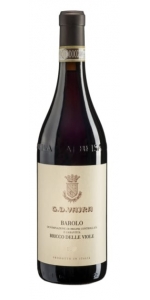
G.D. Vajra Bricco Delle Viole Barolo is made from 100 percent Nebbiolo.
The Barolo Bricco delle Viole shows the signature verticality of its vineyard. The wine is beautifully layered and - while restrained as it’s always the case in the youth of Bricco delle Viole - it also shows a complexity of layers with purple flowers, sweet spices and mineral tones. The palate is noble, with a refined acid spine and profound tannins that promise a long aging potential.
Among the historical vineyards of Barolo, Bricco delle Viole is the highest and the closest to the Alps. It rises from 400 to 480 meters above sea level, on the Western ridge of the village. Its name, “Hill of Violets”, originates from the flowers that blossom early here due to the perfect south exposure. Up above the fogs, Bricco delle Viole enjoys the earliest sunrise and the last sunset every day. Thanks to its vines dating back to 1949 and -now- 1931, a dramatic diuturnal temperature range and this pure light, Bricco delle Viole generates a sophisticated and profound Barolo DOCG of bright aromatics, chiseled tannins and subtle minerality. 2018 is a vintage that shows many nuances of Bricco delle Viole: beyond the signature verticality of this site, the wine offers high tones laced with mineral nuances and plenty of energy and youth.
Review:
The 2018 Barolo Bricco delle Viole is not super intense, but it is balanced in its own way. The wine is subdued but complete with softly yielding tannins to support an elegantly streamlined mouthfeel. Bricco delle Viole is a high and cool growing site in Barolo at 400 to 480 meters in elevation with characteristic Sant'Agata marl soils with fossils. The wine represents a selection of fruit from over seven hectares. With fermentation in steel tank and aging in large Slavonian oak, you are invited to a silky, lifted and beautifully delicate experience with an accessible personality.
-Wine Advocate 95 Points
An elegant version, this red features rose, black currant, cherry, mineral and a hint of eucalyptus aromas and flavors. Linear in profile, this is solidly built on a graceful frame, with finely woven tannins and vibrant acidity.
- Wine Spectator 95 Points
G.D. Vajra Bricco Delle Viole Barolo is made from 100 percent Nebbiolo.
The Barolo Bricco delle Viole shows the signature verticality of its vineyard. The wine is beautifully layered and - while restrained as it’s always the case in the youth of Bricco delle Viole - it also shows a complexity of layers with purple flowers, sweet spices and mineral tones. The palate is noble, with a refined acid spine and profound tannins that promise a long aging potential.
Among the historical vineyards of Barolo, Bricco delle Viole is the highest and the closest to the Alps. It rises from 400 to 480 meters above sea level, on the Western ridge of the village. Its name, “Hill of Violets”, originates from the flowers that blossom early here due to the perfect south exposure. Up above the fogs, Bricco delle Viole enjoys the earliest sunrise and the last sunset every day. Thanks to its vines dating back to 1949 and -now- 1931, a dramatic diuturnal temperature range and this pure light, Bricco delle Viole generates a sophisticated and profound Barolo DOCG of bright aromatics, chiseled tannins and subtle minerality. 2018 is a vintage that shows many nuances of Bricco delle Viole: beyond the signature verticality of this site, the wine offers high tones laced with mineral nuances and plenty of energy and youth.
Review:
A juicy Barolo, with vibrant acidity and a fluid profile that exudes cherry, raspberry, mown hay, mineral and eucalyptus aromas and flavors. Tight yet long, with excellent potential.
#26 Wine Spectator Top 100 of 2023
The last wine poured at my tasting at the winery is the G.D. Vajra 2019 Barolo Bricco delle Viole. With its high vantage point in the hills west of Barolo, Bricco delle Viole is a world apart in terms of soils (with Sant'Agata marl and fossils) and even harvest times. Slow and careful ripening like the kind that characterizes fruit in 2019 renders a very delicate and ethereal expression with floral tones, wild mint and licorice. This organic wine is solid in build and structure. Indeed, Isidoro Vaira remarks that Nebbiolo tannins have changed since the 1970s and 1980s.
-Wine Advocate 97+ Points
Jeweled in appearance, the 2019 Barolo Bricco Delle Viole may be the best wine I have tried yet from Vajra. Its gorgeous and alluring perfume of fresh roses is followed by a Burgundian, elegant red with incredible length and no harsh edges, fine and present tannins, and beautiful, graceful concentration. It is drinking well now, and I will be trying to get my hands on as much of this as possible. Drink 2025-2045.
-Jeb Dunnuck 97 Points
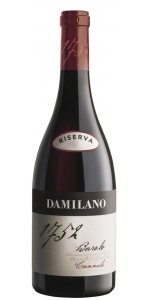
“1752” is the name of the Damilano Barolo Cannubi Riserva, in honor of the year in which the historic bottle was first marked “Cannubi”. It still exists today perfectly conserved by the Manzone family in Bra, close to Barolo. The bottle is clearly marked as being of “1752” vintage, indicating that Cannubi historically precedes Barolo.
About the Vineyard:
The Cannubi Cru is in found within one of the 6 core zones which comprise a UNESCO heritage site in Italy. A mixture of Tortonian and Helvetian calcareous marl gives the grapes intense aromas of cherry, plum and tobacco, rose and violet in sequence. Its low potassium and high calcium/magnesium content offer the wine a fine and polished touch. The vineyard is located at about 270 m. a.s.l. and has a south-east sun exposure. Barolo Riserva Cannubi 1752 It is a small plot of about 2 hectares of Nebbiolo vines, currently between 30 and 50 years of age.
Tasting Notes:
Garnet ruby red in color, the bouquet is intense and balanced, with notes of violet, red fruit, cherry and plum, spices, liquorice, cocoa, leather and tobacco. Dry, robust, full-bodied, very persistent, rich and velvety
Food Pairing:
This wine is excellent with typical piedmontes pasta (tajarin, ravioli); perfect with red meat, braised and roast meat, game and absolutely ideal with all types of cheeses.
Review:
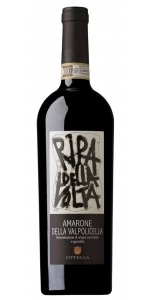
Ripa Della Volta Amarone della Valpolicella 70% Corvina, 20% Corvinone, 5% Oseleta and 5% Spigamonte.
The vineyards are located at an elevation of 300-600 metres above sea level, with a south-southwesterly exposure. Training system: Guyot.
It features an intense red color with garnet highlights. The nose offers up a rich variety of aromas with fruity notes of cherries, morello cherries and plums, spices and hints of chocolate. It is round and caressing with soft, mellow tannins balanced by excellent acidity that enhances its drinkability and ageing potential.
It is a wine with a marked personality, great finesse, elegance, and extraordinary longevity.
It pairs well with main dishes such as game and roasts, but also cured meats and mature cheese.
Review:
Strong, dark ruby with a light garnet edge. Intense and very clearly defined nose with notes of ripe plums, dark forest raspberries and some tobacco in the background. Round on the palate with plenty of supple tannin, pleasantly dry, firm pressure in the finish.
-Falstaff 92 Points
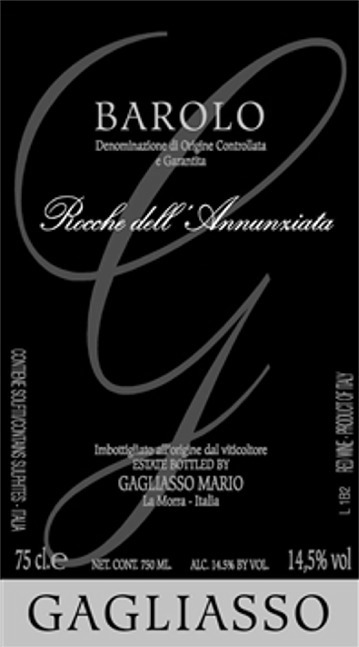
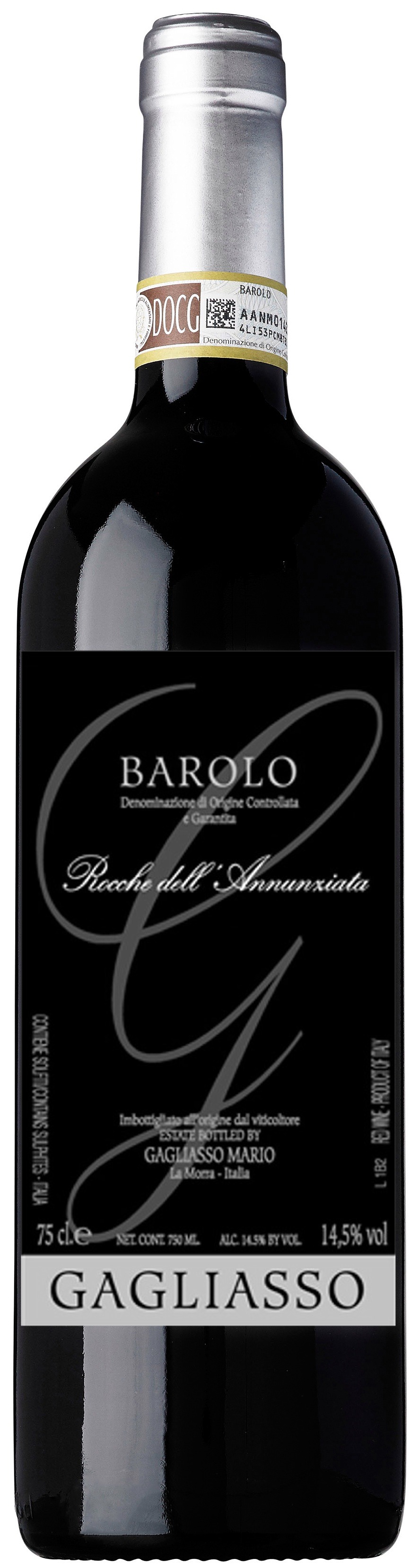
Gagliasso Rocche dell Annunziata Barolo is made from 100% Nebbiolo.
This is a gorgeous wine on many fronts. Firstly, its aromas of wild berry, smoke and cedar are focused and pristine. Secondly, the texture it imparts in the mouth is dense, firm but ultimately yielding and plush. Lastly, the wine's fresh flavors endure for many minutes.
Average density of vines: 5500 vines per hectare Method of cultivation: classical Guyot method with medium-short pruning; the vineyard are three, two with west exposure and one south with medium slope. Green harvest in two different times with reduction of grapes with a production per hectare around 5500 kg . Rocche dell’Annunziata grape are harvested very ripe with a meticulous selection; the fermentation took place in stainless steel vats with temperature controlled. The fermentation is around 33-34°C with 15-17 days of maceration ; malolattic fermentation took place spontaneously in stainless steel vats. After malolattic fermentation the wine stay for 12 month in French barrels, 50% new oak and 50% 2 years; after this period the barrels are blended in big barrels of 2500 liters for 18 month. The wine is bottled and refined for 10-12 month.
The Gagliasso Estate
The Azienda Agricola Mario Gagliasso is located in the town of La Morra, south of Piedmont, in the province of Cuneo, in the Langhe area.
The winery offers one of the most beautiful views over the Langhe area.
La Morra is located at 513 meters above sea-level, 13 km from Alba, on the top of an imposing hill with the Alps and the Monviso as a background. The hill is planted with vines, for ming huge waves and creating an amphitheatre of rare beauty.
Luca Gagliasso’s family has a long history of winemaking. Luca's grandfather began 50 years ago, at which time he bottled the first Barolo from their historic vineyard, Rocche dell'Annunziata. Around 1987, Lucas's father took over the family tradition of producing wine and brought forth a few changes: he started by using barriques from France, together with large barrels and temperature controlled steel vats. He also purchased a new vineyard. Luca began working with his father during the 2000 vintage, only part time for the first 3 years. He also worked for 3 years with their wine consultant in an analysis laboratory, and worked as a consultant for other wineries.
Luca now works alongside his father, mother, and sister on their 12 hectares of vineyards. On the weekends, Luca's sister and mother work in their restaurant as cooks – only the Gagliasso wines are served. They are currently extending their facility and in the future they plan to incorporate some guest rooms to the restaurant.
The Gagliasso family produces around 60,000 bottles: 40% Barolo, 30% Barbera, 20% Dolcetto and 10% Chardonnay. They have around 250 barriques and 6 large barrels.
Dolcetto is very fruity, aged for a small period in big cask. They produce 3 Barolos and 2 Barberas, one aged 18 months in new oak and the other one only in steel vats. They age the Barolo for 18 months in new barriques, then 12 months in a large cask. Chardonnay is cold macerated, then fermented and aged in French oak for 9 months.
Bernardins Beaumes de Venise Rouge Cru Cotes du Rhone is made from 65% Grenache, 25% Syrah, 5% Mourvedre and 5% Grenache Blanc.
Bright ruby color with cherry tinges. Complex black fruit aromas on the nose enhanced by spicy notes. Rounded palate with good length.
The wine is drinking well right now and can be kept for another 10 years.
Situation
Spreads out over the south-east side of the Dentelles de Montmirail hills, in Beaumes de Venise in the southern part of the Rhone valley.
Terroir
On a poor sandy, hungry and arid soil consisting of tender limestone and gritty zones of sandy mollasse.
In the vineyard
The vineyards and their terroir are the essence of our wines. This is where everything starts and where we focus our efforts throughout the year. You can’t make great wine without great grapes.
The viticulture is essentially done by hand. Five people work full-time in the vineyards. They are supplemented by seasonal employees who work during bunch thinning and the harvest in order to bring out the very best in our vines. Working by hand and the attention each vine gets are fundamental. Pruning, de-budding, trellising, leaf removal and picking are thus carried out by hand with the utmost care.
We prepare the soil by using good old-fashioned ploughing. Organic compost is made from grape marc (the discarded stalks and skins).
As a way of protecting the plants, we only use phytosanitary products when necessary and within strict guidelines by staggering the treatments appropriately, to minimise the amount of chemicals used. We prefer to use as much as possible manual and organic techniques . Leaving natural grass cover, removing buds and leaves from the vines, preserving biodiversity around the vineyard: olive, almond and cypress trees, wild rosemary and capers.
Winemaking
We make two red wines at the estate. Terroir wines shaped by the two classic Côtes du Rhône varieties: Grenache and Syrah. We don’t follow any winemaking recipe but are constantly searching for the perfect expression of terroir and each vintage’s particular characteristics. We don’t go for overripe grapes and over-extraction, as we think the wine has to stay refreshing and balanced.
Leaving the wine for 15 days in concrete vats, we try to gently extract the tannins and anthocyanins essential for the wine’s structure and colour. The wine doesn’t come into any contact with wood during ageing. This way the characteristics of our terroir can fully express
Serve with a meal especially red meat, game and cheese.
Review:
"Smoky bacon, bay leaf and olive brine. This is very fine for a whole-bunch style, with lovely tannic finesse and texture. Powerful, tannic and cleansing, yet compact, with driving acidity, a dry, savoury finish and perfect balance. A good vintage, for what is a reliably good-value southern Rhône pick. Vineyards in conversion to organic; fruit is whole-bunch fermented.- Matt WALLS"
- Decanter (October 1st 2024), 94 pts
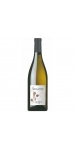
Michel Thomas Sancerre Blanc is 100% Sauvignon Blanc (40% Caillottes, 40% Grosses Terres, 20% Silex)
The wine displays an exotic nose with a touch of smoke and licorice. On the palate, peach and watermelon dominate with citrus zest and chalk notes.
Aged on the lees for a few months (no oak). It goes well with seafood, fish, goats cheese.