" We don't sell the wine without touching the vine "

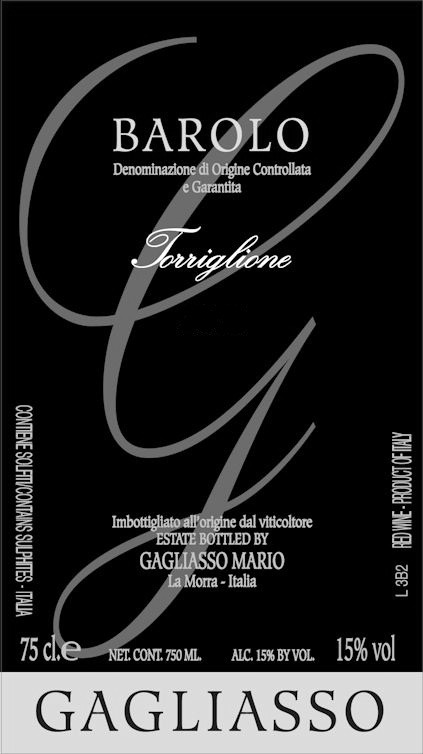
Gagliasso Torriglione Barolo is 100% Nebbiolo
Aged 12 months in French Oak barrels (50% new, 50% second use), then the wine is blended in big 2500 liter foudre for 18 months. And finally, the wine is aged in the bottle for 12 months before release.
The wine offers a free range of blackberry, cassis, tar, leather and tobacco-like aromas. But, in the mouth you'll taste the jamminess and maturity of the fruit. It's a smooth, soft wine with a long strawberry fade.
Average density of vines: 5500 vines per hectare Classical Guyot method with medium-short pruning; vineyard with south exposure with medium slope. Green harvest in two different times with reduction of grapes with a production per hectare around 5500 kg . Torriglione grape are harvested very ripe with a meticulous selection; the fermentation took place in stainless steel vats with temperature controlled. The fermentation is around 33-34°C with 15-17 days of maceration ; malolactic fermentation took place spontaneously in stainless steel vats. After malolattic fermentation the wine stay for 12 months in French barrels, 50% new oak and 50% 2 years; after this period the barrels are blended in big barrels of 2500 liters for 18 months. The wine is bottled and refined for 10-12 months.
Gagliasso Torriglione Barolo is 100% Nebbiolo
Aged 12 months in French Oak barrels (50% new, 50% second use), then the wine is blended in big 2500 liter foudre for 18 months. And finally, the wine is aged in the bottle for 12 months before release.
The wine offers a free range of blackberry, cassis, tar, leather and tobacco-like aromas. But, in the mouth you'll taste the jamminess and maturity of the fruit. It's a smooth, soft wine with a long strawberry fade.
Average density of vines: 5500 vines per hectare Classical Guyot method with medium-short pruning; vineyard with south exposure with medium slope. Green harvest in two different times with reduction of grapes with a production per hectare around 5500 kg . Torriglione grape are harvested very ripe with a meticulous selection; the fermentation took place in stainless steel vats with temperature controlled. The fermentation is around 33-34°C with 15-17 days of maceration ; malolactic fermentation took place spontaneously in stainless steel vats. After malolattic fermentation the wine stay for 12 months in French barrels, 50% new oak and 50% 2 years; after this period the barrels are blended in big barrels of 2500 liters for 18 months. The wine is bottled and refined for 10-12 months.

Gagliasso Barolo Riserva Oak Box is made from 100% Nebbiolo
Complex and intense aromas of red fruits intermixed with licorice, prune, leather, smoke and notes of toasty oak and vanilla. Full-bodied on the palate with loads of ripe dried and candied fruits, pepper and mocha.
After malolattic fermentation the wine stays for 10 months in French barrels, 10% new oak and 90% different years; after this period all barrels are blended ( 50% Torriglione and 50% Rocche dell’Annunziata) in old barrels for 48 months again. The wine is bottled and refined for 24 months.
There's a gritty, sandy quality to the tannins that would cut through roast pork stuffed with prunes.

Boroli Barolo Brunella is made from 100 percent Nebbiolo.
A clear ruby red color, with very light orange reflections. A net aroma in which liquorice stands out at first, immediately followed by a fruity scent; the aroma makes you scent it again and again to discover different and pleasant facets. The fruity aroma magnificently prevails after a few minutes in the glass. A very enveloping, fresh and harmonious taste, with a delicate and tasty presence of wood. A long lasting taste that invites to sip it slowly again and again.
Tasting Notes
Brunella is distinguished by a careful selection of grapes, perfect destemming, long macerations with submerged cap. The barrels for Brunella are specifically chosen by the winemaker.
Wine Production
Brunella is one of the most historic single vineyard sites of all of Castiglione Falletto, however it hasn’t ever been bottled singularly under the Menzione Geografica Aggiuntiva BRUNELLA until 2013. The Brunella vineyard occupies the western crest of the Villero hillside and complete surrounds the Boroli winery. The vineyard is a monopole—owned entirely by Boroli and is the most prestigious wine in the lineup. As it occupies the best exposed section of the Villero hillside, La Brunella expresses power, drive, complexity, and extraordinary length and ageability.
About the Vineyard
The Boroli family is a family of entrepreneurs, with roots in Piedmont dating back to 1831. The family started their winemaking business in1997, when Silvano and Elena Boroli felt an ardent desire to step away from the pressures of their publishing business and reconnect to nature. Silvano and Elena grew the company until their son, Achille, stepped in to run the wine-growing and production business in 2012.
With the 2012 grape harvest Achille decided to radically change the methods used in vineyards and wineries, aiming for the highest quality in Barolo and its crus. He cut production levels, updated the winemaking technology, and focused on low intervention methods to raise the quality of the Boroli wines be on par with the finest Barolo wines.
Review:
Ripe red cherries and blood oranges, as well as herbs and roses on the nose, leading to a juicy and flavorful palate that has a swathe of bright, juicy red-fruit flavor. Drinking well now.
-James Suckling 93 Points

Boroli Cerequio is made from 100 percent Nebbiolo.
The Boroli family is a family of entrepreneurs, with roots in Piedmont dating back to 1831. The family started their winemaking business in1997, when Silvano and Elena Boroli felt an ardent desire to step away from the pressures of their publishing business and reconnect to nature. Silvano and Elena grew the company until their son, Achille, stepped in to run the wine-growing and production business in 2012.
With the 2012 grape harvest Achille decided to radically change the methods used in vineyards and wineries, aiming for the highest quality in Barolo and its crus. He cut production levels, updated the winemaking technology, and focused on low intervention methods to raise the quality of the Boroli wines be on par with the finest Barolo wines.
About the Vineyard
The Cerequio cru lies just across the valley from the Boroli winery in the commune of La Morra and is considered one of the most prestigious sites in the Barolo DOCG zone. It is known to produce Nebbiolo wine of enormous elegance and finesse.
Wine Production
Cerequio is distinguished by a careful selection of grapes, precise destemming, and a long maceration with submerged cap.
Tasting Notes
A clear bright ruby color with very light garnet red reflections; intense and persistent aroma of red fruit with notes of plum and cherry. A pleasant aroma of wood is noticeable after the fruity aroma, anticipating the full taste of a great wine suitable for long lasting life. A succulent, rich, full-bodied and pleasant taste emerges after the woody one, with the presence of slightly ripe red fruit.
Food Pairing
Thanks to its viscosity and body, Barolo is the ideal wine to pair with elaborate dishes and dishes like truffle dishes, meat dishes, pasta with porcini mushrooms, game, and aged cheeses. Cerequio is also perfect with dry pastries or chocolate.
Review:
Elegant bright ruby red. Fragrant and inviting nose of strawberries with whipped cream, icing sugar, elderflower and roses. Flattering palate with clear fruit and appealing acidity, unfolds into a complex style, punchy on the palate with a clear, slightly salty finish.
-Falstaff 95 Points

J. Christopher Appassionata Fortissimo Pinot Noir is made from 100 percent Pinot Noir.
Inspired by the three movements of Beethoven’s “Appassionata” Piano Sonata, there are three Appassionata Pinot Noirs, released at different tempos.
The finale of the Appassionata Pinot Sonata is Fortissimo (dynamically forceful). Selected for ultimate expressivity and longevity, it is not released until 10 years after the vintage. This is the epitome of expressive excellence that we are seeking in Willamette Valley Pinot Noir – a wine that combines brooding intensity with lilting grace and can stand alongside the classic wines of the world. The 2012 Fortissimo is muscular and full-bodied, with a deep color and seamless structure. In this phase of maturation, tertiary aromas begin to show a profound complexity and subtle earthiness that only develops with bottle age and cannot be accelerated
Review:
Loosen Bros. and J. Christopher Wines just released the Fortissimo and it is showing great acidity and fine-grained tannins. Its aromas and flavors of sweet red cherries, roasted pork shoulder and orange-pekoe tea are alive and kicking. Enjoy 2023–2032.
-Wine Enthusiast 95 Points
More intense than you might expect from an 11 year old Pinot Noir, certainly one that has been held back at the estate for 10 years before release. Grilled raspberry leaf and reductive smoky notes greet you on the nose here, with sweet black fruits softening the tangy red cherry and cranberry of Oregon Pinot, all wrapped up with waves of leather, sage and tobacco. This has power and succulence, and even at 10 years old it feels pretty young, just at the beginning of its development with a good decade ahead of it. Late release is an unusual approach in Oregon, but not so unusual if you follow Loosen’s winemaking in the Mosel, where he has been known to keep Riesling between 20 and 30 years in barrel. In this case the barrel ageing is for around two years, with the rest taking place in the bottle. Old fashioned winemaking, delicious results. 20% new oak. Fermented with natural yeast, unfiltered and unfined. Tim Malone winemaker. First time on the Place from this wine, from a vineyard in the foothills of the Chehalem Mountains in Oregon’s Willamette Valley. Heavy bottle.
- Jane Anson - Inside Bordeaux 97 Points
The wine offers a free range of blackberry, cassis, tar, leather and tobacco-like aromas. But, in the mouth you'll taste the jamminess and maturity of the fruit. It's a smooth, soft wine with a long strawberry fade.
The Gagliasso Estate
The Azienda Agricola Mario Gagliasso is located in the town of La Morra, south of Piedmont, in the province of Cuneo, in the Langhe area.
The winery offers one of the most beautiful views over the Langhe area.
La Morra is located at 513 meters above sea-level, 13 km from Alba, on the top of an imposing hill with the Alps and the Monviso as a background. The hill is planted with vines, for ming huge waves and creating an amphitheatre of rare beauty.
Luca Gagliasso’s family has a long history of winemaking. Luca's grandfather began 50 years ago, at which time he bottled the first Barolo from their historic vineyard, Rocche dell'Annunziata. Around 1987, Lucas's father took over the family tradition of producing wine and brought forth a few changes: he started by using barriques from France, together with large barrels and temperature controlled steel vats. He also purchased a new vineyard. Luca began working with his father during the 2000 vintage, only part time for the first 3 years. He also worked for 3 years with their wine consultant in an analysis laboratory, and worked as a consultant for other wineries.
Luca now works alongside his father, mother, and sister on their 12 hectares of vineyards. On the weekends, Luca's sister and mother work in their restaurant as cooks – only the Gagliasso wines are served. They are currently extending their facility and in the future they plan to incorporate some guest rooms to the restaurant.
The Gagliasso family produces around 60,000 bottles: 40% Barolo, 30% Barbera, 20% Dolcetto and 10% Chardonnay. They have around 250 barriques and 6 large barrels.
Dolcetto is very fruity, aged for a small period in big cask. They produce 3 Barolos and 2 Barberas, one aged 18 months in new oak and the other one only in steel vats. They age the Barolo for 18 months in new barriques, then 12 months in a large cask. Chardonnay is cold macerated, then fermented and aged in French oak for 9 months.

Perchaud Chablis Premier Cru Fourneaux is made from 100 percent Chardonnay.
This is the south facing portion of the slope and very hot, heavy "Fourneaux" or "oven" effect.
The wine is expressive and vivacious with beautiful aromas.
Well-balanced, round and fruity wine with a fine minerality on the finish.
1er Cru Fourneaux is located on the Fleys village and faces the field. the plots are very steep and exposed full south on soil type Kimmeridgian consists of marl clay-limestone with shallow ground and a very stony ground. After a slight settling, the juice starts its fermentation in tank, then ¼ of juice is racked in barrels. Both wines perform their alcoholic fermentation and malolactic and their aging on the lees, separately. The two cuvées are blended six months after harvesting. The wine is then filtered and is bottled 15 months after harvesting. 2013 Conditions and Harvest The relatively high temperatures at the end of winter allowed an early bud vines in early March. With a hot, dry spring flower took place in good conditions. In July, a hailstorm located did some damage to our Fourchaume plot. July and early August, rainy and stormy brought the water needed by the vineyards. The dry and sunny weather of the second half of August brought the grapes to maturity. The harvest began on September 2 under cloudy skies.
Coquille St. Jacques (scallops) with leeks and cream.

Mt Monster Shiraz is 100 percent Shiraz
Deep purple in color. Ripe cassis and black plum fruits on the nose with violets. Varietal fruit-driven palate, with cassis and dark berryfruit and spice flavors. Soft tannins compliment the fruit with mouth-filling generous finish.
French & American oak has been used sparingly to ensure maximum fruit expression is retained in the final wine.
Our Shiraz is fermented in static fermenters at controlled temperatures to retain the varietal aromatics. Once complete the wine is left for 7–10 days on skins to aide in the extraction of soft fleshy tannins and build wine structure.