" We don't sell the wine without touching the vine "
| Country: | France |
| Regions: | Rhone Chateauneuf du Pape |
| Winery: | Grand Veneur |
| Grape Type: | Roussanne |
| Organic: | Yes |
| Vintage: | 2022 |
| Bottle Size: | 750 ml |

Grand Veneur Chateauneuf du Pape Blanc Le Miocene is made from 60% Clairette, 40% Roussanne
Pale yellow colour with hints of green, aromas of white flowers (may blossom, honeysuckle).
The palate is pleasantly balanced between liveliness and roundness, which brings out characteristics of dried apricot, honey and elderberry. A Châteauneuf du Pape white displaying a great finesse.
Best between 1 and 8 years.
Soil type Coming from the single vineyard named “La Fontaine”, the plot is facing north.It is made of clay-sand and limestone. Thanks to the northern orientation, it is always very well aired. This sector allow the Roussane and Clairette to mature in great conditions without losing freshness, which we believe is key point. Winemaking & ageing Whole-bunch pressing. Vinification in stainless-steel tanks. Fermentation temperature controlled at 15°C.
Review:
"The classic white from this estate is the 2021 Châteauneuf Du Pape Le Miocene Blanc, and it shines in the vintage. Based on 60% Clairette and 40% Roussanne, it has a lighter gold hue as well as textbook aromatics of citrus, pears, and minty herbs. I love its balance, it’s medium-bodied, has the vintage’s fresher style, and outstanding length. It should evolve gracefully, and while the safe bet is to enjoy bottles over the coming 2-4 years, I wouldn’t be surprised to see this evolve for well over a decade."
- Jeb Dunnuck (November 2022), 92 pts
Grand Veneur Chateauneuf du Pape Blanc Le Miocene is made from 60% Clairette, 40% Roussanne
Pale yellow colour with hints of green, aromas of white flowers (may blossom, honeysuckle).
The palate is pleasantly balanced between liveliness and roundness, which brings out characteristics of dried apricot, honey and elderberry. A Châteauneuf du Pape white displaying a great finesse.
Best between 1 and 8 years.
Soil type Coming from the single vineyard named “La Fontaine”, the plot is facing north.It is made of clay-sand and limestone. Thanks to the northern orientation, it is always very well aired. This sector allow the Roussane and Clairette to mature in great conditions without losing freshness, which we believe is key point. Winemaking & ageing Whole-bunch pressing. Vinification in stainless-steel tanks. Fermentation temperature controlled at 15°C.

Grand Veneur Chateauneuf du Pape Rouge Le Miocene is made from 70% Grenache, 20% Syrah, 10% Mourvèdre .
An intense dark-ruby color. The nose develop aromas of ripe black fruit (such as blackberry), cherry and spice box. The palate reveals the presence of tannins, in high quantity and elegant. The finish is long and luxurious. This is the Châteauneuf du Pape expression, displaying all the characteristics of the terroir.
Soil type: Plots are located northern part of Châteauneuf du Pape and the vines are grown under organic process.The soil is marked by the violence wrought by the Rhone river. It consists of a layer of marine molasses of the Miocene period covered by alpine alluvium. The presence of a great number of rounded stones known as "galets" in the earth is evidence of the time when the Rhone, then a torrent, tore fragments of rock from the Alps and deposited them on the plain. The GRAND VENEUR cuvee will express year after year a great power and aromatic complexity.
Winemaking & ageing: Harvest is sorted by hand, destemmed and crushed. Fermentation temperature is controlled at 30°C. Vatting period of 18 to 20 days. Matured in vats and oak casks.

Grand Veneur Chateauneuf du Pape Rouge Le Miocene is made from 70% Grenache, 20% Syrah, 10% Mourvèdre .
An intense dark-ruby color. The nose develop aromas of ripe black fruit (such as blackberry), cherry and spice box. The palate reveals the presence of tannins, in high quantity and elegant. The finish is long and luxurious. This is the Châteauneuf du Pape expression, displaying all the characteristics of the terroir.
Soil type: Plots are located northern part of Châteauneuf du Pape and the vines are grown under organic process.The soil is marked by the violence wrought by the Rhone river. It consists of a layer of marine molasses of the Miocene period covered by alpine alluvium. The presence of a great number of rounded stones known as "galets" in the earth is evidence of the time when the Rhone, then a torrent, tore fragments of rock from the Alps and deposited them on the plain. The GRAND VENEUR cuvee will express year after year a great power and aromatic complexity.
Winemaking & ageing: Harvest is sorted by hand, destemmed and crushed. Fermentation temperature is controlled at 30°C. Vatting period of 18 to 20 days. Matured in vats and oak casks.

Grand Veneur Chateauneuf Du Pape Vieilles Vignes is made from 50% Grenache, 40% Mourvedre, 10% Syrah
Matured in concrete vats (40%) and oak casks (60%)
It boasts an inky/purple color in addition to a gorgeous perfume of crushed rocks, jammy black fruits, charcoal and graphite. Blackberry aroma with an air of dates pressed in alongside – this is sweet-noted. It is easy to appreciate, a sleek and stylish start. The palate holds excellent fruit that runs well and has kick. Its tannins move round freely and a minted finale comes forward. Its dark fruit is tasty, darkens on the finish, where tar and char from its oak enter. It is all very much together, a bundle of harmony, and will gain local attributes as it ages.
An outstanding Chateauneuf du Pape which display the best of its terroir.
The vines are 50 to 100+ year old. They are planted on red clay soils covered with pebble stones.
Harvest is destemmed and crushed. Fermentation temperature is controlled at 30°C. Vatting period of 18 to 20 days. Matured in concrete vats (40%) and oak casks (60%).
The vineyards are located in the north of Châteauneuf du Pape. GRAND VENEUR «Vieilles Vignes» cuvee is produced from the older vines. Thanks to time and an organic growing, roots go very deep in the soil. Yields are naturally low and grapes highly concentrated.
The vines are 50 to 100+ year old. They are planted on red clay soils covered with pebble stones.
Winemaking and aging
Harvest is destemmed and crushed. Fermentation temperature is controlled at 30°C. Vatting period of 18 to 20 days. Matured in concrete vats (40%) and oak casks (60%).
Pair with venisson, duck, braised lamb or strong cheese.
Review:
"Up with the crème de la crème of the vintage, the 2018 Châteauneuf Du Pape Vieilles Vignes is a bigger, richer wine than the Les Origines cuvée and has a beautiful core of smoked black fruits, candied violets, peppery garrigue, and scorched earth-like aromas and flavors. Playing in the medium to full-bodied end of the spectrum, it’s flawlessly balanced and has terrific tannins, a stacked mid-palate, and a great finish. It certainly shows the more front end-loaded, fleshy, mildly concentrated style of the 2018 vintage, yet the balance is top-notch, and it’s just a thrill to drink today. It should evolve nicely for 10-15 years."
- Jeb Dunnuck (October 2020),96 pts
Grand Veneur Chateauneuf Du Pape Vieilles Vignes is made from 50% Grenache, 40% Mourvedre, 10% Syrah
Matured in concrete vats (40%) and oak casks (60%)
It boasts an inky/purple color in addition to a gorgeous perfume of crushed rocks, jammy black fruits, charcoal and graphite. Blackberry aroma with an air of dates pressed in alongside – this is sweet-noted. It is easy to appreciate, a sleek and stylish start. The palate holds excellent fruit that runs well and has kick. Its tannins move round freely and a minted finale comes forward. Its dark fruit is tasty, darkens on the finish, where tar and char from its oak enter. It is all very much together, a bundle of harmony, and will gain local attributes as it ages.
An outstanding Chateauneuf du Pape which display the best of its terroir.
The vines are 50 to 100+ year old. They are planted on red clay soils covered with pebble stones.
Harvest is destemmed and crushed. Fermentation temperature is controlled at 30°C. Vatting period of 18 to 20 days. Matured in concrete vats (40%) and oak casks (60%).
The vines are 50 to 100+ year old. They are planted on red clay soils covered with pebble stones.
Harvest is destemmed and crushed. Fermentation temperature is controlled at 30°C. Vatting period of 18 to 20 days. Matured in concrete vats (40%) and oak casks (60%).
The vineyards are located in the north of Châteauneuf du Pape. GRAND VENEUR «Vieilles Vignes» cuvee is produced from the older vines. Thanks to time and an organic growing, roots go very deep in the soil. Yields are naturally low and grapes highly concentrated.
Winemaking and aging
Pair with venisson, duck, braised lamb or strong cheese.
Review:
"The 2021 Châteauneuf Du Pape Vieilles Vignes is even more powerful, with a dense purple color as well as serious notes of blackberries, currants, ground pepper, graphite, chocolate, and violets. I love its mid-palate density, it's medium to full-bodied, has building tannins, and a great finish. It's going to need short-term cellaring, but it’s one heck of an impressive 2021."
- Jeb Dunnuck (November 2021),94-96 pts
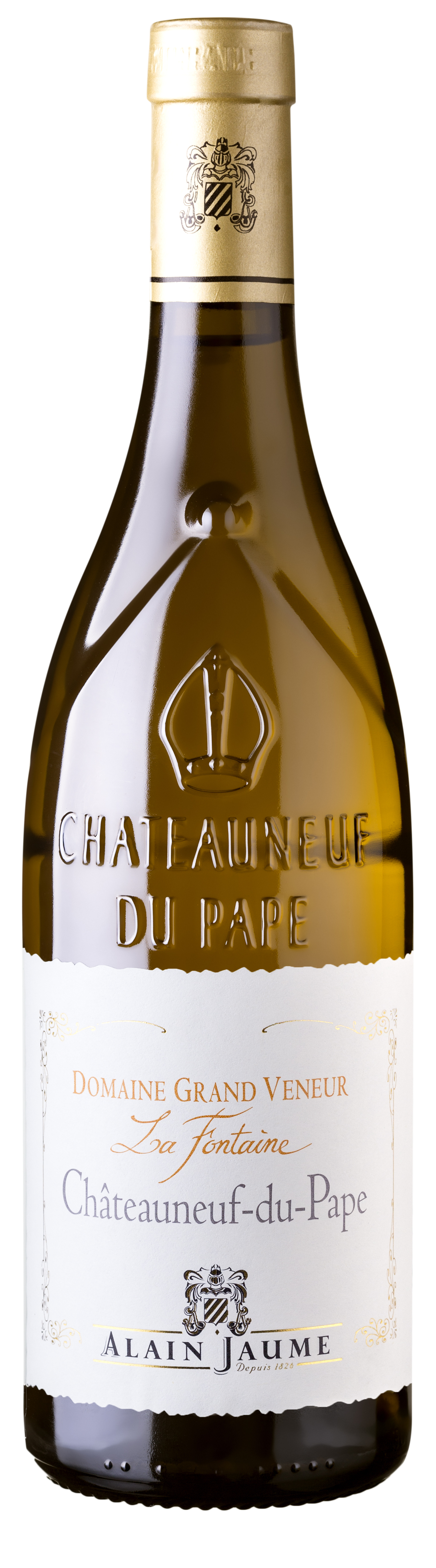
Grand Veneur Chateauneuf Du Pape Blanc La Fontaine is made from 100% Roussane.
Yellow-gold color. The nose is rich in aromas of citrus fruit, tropical fruit, quince and honey, with a touch of vanilla. On the palate, the same aromas appear together with a fatness combining exotic fruit and vanilla : the wine is rich, generous and elegant, with extraordinary length. "La Fontaine" is often considered to be one of the best Châteauneuf du Pape white, and it is by definition a superb gastronomy wine.
Best between 1 and 8 years.
Review:
"Always all Roussanne, the 2022 Châteauneuf du Pape La Fontaine Blanc comes from organically grown grapes and was brought up entirely in oak. It's a brilliant white that would compete with a Grand Cru White Burgundy with its smoky stone fruits, brioche, crushed stone, and floral aromatics. Full-bodied on the palate, with a deep, layered mouthfeel, huge richness, and a great finish, this is legit awesome white wine that I'd be thrilled to have in the cellar. I love it today yet see no reason it shouldn't evolve gracefully for at least a decade."
- Jeb Dunnuck (Importer Highlight: Fran Kysela ; July 2024), 97 pts
The Grand Veneur Estate
In 1320 Pope Jean XXII planted the first vines of Chateauneuf-du-Pape, but it was only in 1360 that the wines of the region first gained fame. Oddly, the wine that gave Chateauneuf-du-Pape its original reputation was the Blanc and not the Rouge. The white wine was a favorite of Pope Innocent VI. The Domaine dates back to 1826, having been founded at that time by Mathieu Jaume. Since 1979, Alain Jaume has run the Domaine and now has the help of his two sons: Sebastien and Christophe.
"Popes throughout history have liked their juice, and when the papal see moved to Avignon in the 13th century, that juice was Chateauneuf-du-Pape ("the pope's new castle") made from grapes grown nearby in the Southern Rhone. The castle is a ruin now, the papal court long gone back to Rome, but the wines that bear the pope's coat of arms emblazoned on the bottle are still produced more or less according to the long-standing recipe. Not every winemaker uses all 13 of the grapes in the proscribed blend, though. At Domaine Grand Veneur, an estate that dates to 1826, Alain Jaume and his sons Sebastien and Christophe emphasize Grenache blended with Syrah and Mourvedre."
- Los Angeles Times
"Improved Chateauneuf with very accomplished, stylish reds since the late 1990s; also very good Vacqueyras and Cotes-du-Rhone Villages." - Anthony Dias Blue's pocket guide to wine 2006
"Grand Veneur is one of the most brilliant estates in Chateauneuf du Pape as well as the force behind the negociant wines sold under the Alain Jaume label. Virtually everything they produce has merit. Some of this estate’s 2009 red wines are just hitting the market as they are bottled early to preserve their fruit and freshness. I can’t say enough about the job Alain Jaume’s two sons, Sebastian and Christophe, have done with this estate. The impeccable attention to detail in the vineyards, the meticulous vinification, and the careful bottling benefit every consumer." - Wine Advocate (#190, August 2010)
"Great bargains continue to emerge from Domaine Grand Veneur as well as from their negociant arm of the business, labeled Alain Jaume" - Wine Advocate (#195, June 2011)
"Don't miss the following "Best Buys" reviewed in several previous issues: Alain Jaume 2010 Cotes du Rhone Haut de Brune (87), Grand Veneur 2010 Cotes du Rhone Blanc (88), Grand Veneur 2009 Cotes du Rhone Les Champauvins (89), Grand Veneur 2009 Cotes du Rhone Reserve Blanc (89), Grand Veneur 2010 Cotes du Rhone Blanc (91), Grand Veneur 2010 Cotes du Rhone Rose (86), Grand Veneur 2009 Lirac Clos de Sixte (91), and Grand Veneur 2010 Cotes du Rhone Blanc de Viognier (89). Credit Christophe and Sebastian Jaume for making this one of the most impeccably run estates in the Rhone Valley. To reiterate, this is an estate at the top of its game and the wines remain fairly priced as well. The 2010 Grand Veneur Chateauneuf du Papes reveal youthful, crisper, more focused styles than their 2009 counterparts. I suspect their pHs are lower, the total acids slightly higher, and the alcohols perhaps .5 to 1% lower across the board." - Wine Advocate (issue197, October 2011)"
The Grand Veneur Vineyard
The estate is located in the commune of Orange and consists of 50 hectares (123 acres). It covers four different appellations: Chateauneuf-du-Pape, Cotes-du-Rhone Villages, Cotes-du-Rhone and Lirac.
The family produces wines under two labels:
- Domaine Grand Veneur – Estate
- Alain Jaume – Negociant
Some wine by Grand Veneur:
Annual production:
- Cotes du Rhone Villages CHAMPAUVINS : +/- 9,000 cases
- Lirac Rouge CLOS DE SIXTE : +/- 5,000 cases
- Chateauneuf du Pape Rouge Grand veneur : 3,300 cases
- Chateauneuf du Pape Blanc Grand veneur : 400 cases
- Chateauneuf du Pape LES ORIGINES red : 1,700 cases
- Chateauneuf du Pape LA FONTAINE white : 300 cases
- Chateauneuf du Pape VIEILLES VIGNES : 530 cases

Mordoree Lirac Blanc Reine des Bois is made from Grapes : Grenache 35 % Clairette 25 % Viognier 10 % Roussanne 15 % Marsanne 10 % Picpoul 5%>
Color : green gold
Aromas : white fruits, peach, apricot, pear, violet.
Palate : rounded, long finish, highly flavoured.
Ageing Potential : 4-5 years.
Surface : 4 Ha. Yield : 35 Hl./Ha. Vineyard age : 30 years Terroir : Clay / chalk with pebble stones. Harvest : by hand Vinification : skin maceration and direct pressing with temperature control. Fermentation : oak barrel fermentation for 25% of the total volume
Pairs well with appetizers, fish, seafood.
Review:
"Iconic grapes of 35% Grenache, 25% Clairette, 10% Viognier, 15% Roussanne, 10% Marsanne, and 5% Picpoul from 40-year-old vines make up this organic Southern Rhône white. A floral bouquet of white tea and jasmine make their designs on a defined slate mouthfeel. Lime pops with a tart center, along with notes of peach and gingerbread on a keen, edgy finish."
- The Somm Journal (Feb/March 2022), 94 pts

Saumaize Michelin Pouilly Fusse Premier Cru La Marechaude is made from 100 percent Chardonnay.
A beautiful Pouilly-Fuisse from "La Marechaude" parcel that Saumaize-Michelin acquired in 2013. Planted on clay and limestone slopes and hand harvested, this Chardonnay offers fresh and elegant notes of white flowers, crisp, citrus and exotic fruits. Powerful and mineral on the palate with a fantastic balance, finesse and freshness. The exceptional terroir brings minerality and juicy flavors of stone fruits, peach and melon supported by subtle toasty notes.
It is now a Premier Cru.
Jasper Morris - Inside Burgundy 94 Points

Paul Hobbs Russian River Pinot Noir is made from 100 percent Pinot Noir.
Sourced predominately from the estates that are defined by their proximity to the coast and Russian River climate, the wine displays vivid crimson and aromas of violet, Morello cherry, and black tea. Velvet tannins on the palate ride along a juicy backbone of flavors such as cranberry, Blood orange, and Damson plum. The finish is long, powered behind a crisp acidity and appealing red clay-like minerality.

Mordoree Chateauneuf-du-Pape La Reine des Bois is made from 80% Grenache, 10% Mourvèdre, and the rest equal parts Syrah and Vaccarèse .
This premium cuvee - whose name means "Queen of the Woods" - is from 65-year-old vines, planted on Villafranchian-era terrasses. Yield is 30 hl/ha.
Deep ruby red; opaque. Aromas of red fruits change to wooden touches of leather, black truffles and coffee. Fat, concentrated and full flavored with a very long liquoriced and fruity finish.
Review:
The 2022 Châteauneuf du Pape Cuvée De La Reine Des Bois is based on 75% Grenache, 10% each Syrah and 10% Mourvèdre, and the rest Counoise and Vaccarèse. It's not massive yet just exudes class and elegance, with both red and black fruits that give way to more spice, peppery garrigue, and leather, with classic background licorice and black olive notes. Medium to full-bodied, beautifully balanced, and elegant, with silky tannins, this brilliant Châteauneuf du Pape will evolve for two decades.
Number 36 in Dunnuck's Top 100 and 97 Points
"Huge and powerful, but so fresh. This has great driving intensity, with even bigger, more structural tannins than the domaine’s other cuvée. A rampaging Châteauneuf that will take time to settle, and will always be wild. Long, vibrant and chiselled. An absolute beast. Mordorée has been massive but overripe in the past; it's still massive but with this vintage the ripeness is more controlled, and it has transformed into something extraordinary. Fermented and aged 80% in stainless steel, the rest in old barrels. - Matt WALLS"
- Decanter Magazine (September 17th 2023, Part of Châteauneuf-du-Pape 2022: Report and top-scoring wines), 98 pts

Louis Barruol describes the microclimate of the vineyard Malleval as “very cold” which allows the grapes to retain acidity and showcase the floral aromas of the local Sérine variety. Aromas and flavors of blackberries and wild strawberries are accented by notes of peppercorns, tobacco, peonies, and violets.
Syrah, with its deep flavors and firm tannins, is a natural match for grilled or smoked meat and dishes featuring herbs, roasted mushrooms, and onions. Seared venison or beef with black pepper and thyme or a Moroccan tagine of pigeon or chicken are complimented by the spicy characteristic of Syrah.
Review:
This rich and impeccably balanced Gigondas has everything we look for in the wines of this appellation. What a wide spectrum of aromas with everything from raspberry to candied orange, plus a slew of delicate spicy notes and fresh Mediterranean herbs. I love the interplay of richness, fine tannins and lively acidity on the generous, but not expansive palate. Very long, refined finish. From organically grown grapes. Drink or hold.
-James Suckling 94 Points
Powerful, with steeped plum and cherry coulis merging with potpourri and charred garrigue on a ripe, lush palate. Packs a wall of iron that provides a ballast for the ripe fruit, while refined tannins build in intensity. Long and complex, with a gorgeous expression of place. Grenache, Mourve`dre, Syrah and Cinsault.
Wine Spectator 94 Points

Obsidian Vineyard Syrah is bathed in terroir. The vines experience severe stress, pushing the roots ever deeper through rock in search of water, producing miniature clusters of intense power. Given the wine’s natural propensity for tannin, we take extreme care in the cellar to chisel/whittle its rough edges and leave room for richness to flatter its distinctive scaffold. The mid-palate supports flavors of roasted coffee beans, sarsaparilla, and dark chocolate. The finish marches on long after most wines have tired.
Our estate vineyard — the six-acre Obsidian Vineyard in the Knights Valley AVA — has an incredibly complex soil structure. It takes its name from a layer of volcanic obsidian rock that was discovered when we drilled for water.
Chocolate ganache, black currants, fig, graphite, and an expansive mouthfeel.
Review:
"Joe Donelan believes his Obsidian Vineyard is one of the world’s greatest sites for Syrah. I’ve visited the site twice, and can say candidly it certainly sits among the most striking vineyards I've ever laid eyes on within the U.S. It sits like a rock on a promontory—two switchbacks to reach the top—and the stones under the top soil, quite literally, never stop emerging from the ground. The place has an ancient, almost sacred, temple-like feel. It is consistently swept by afternoon breezes. The vineyard was replanted in 2017 after fires ravaged it. Winemaker David Milner laid out the site at denser spacing than before, at 2,000 vines per acre to keep yields per vine low while still achieving sensible tonnage, averaging around three tonnes per acre. Viognier was planted for co-fermentations, alongside some Cabernet Sauvignon, for a single vineyard bottling of that grape. ‘God put on his viticultural hat when he designed this site,’ says Milner. The vineyard is planted with ENTA 174, 877, and Alban 1 clones, along with Donelan Heritage selections certified virus-free. The wine, the 2023 vintage release (the first from the new vines), was aged for 21 months in 36% new oak and co-fermented with 1.8% Viognier, using 32% whole clusters. And it is positively gorgeous: composed of nine different blocks, each fermented separately, then assembled through sequential blending, with no racking until bottling. From just five-year-old vines, this wine is utterly extraordinary—something oddly achievable from young vines on rare occasion. I tasted this wine from the same bottle over three days. While the high-toned espresso-bean and cedar accents are present at first pull of the cork, they mellow out a day later, and the fruit profile is so vibrant. This is the sign of an excellent wine. I first tasted wines from the Donelan’s Obsidian Vineyard years ago at Tasting Panel Magazine in the late, great Anthony Dias Blue’s office. Cushing Donelan showed the wines, and to this day, I recall the first moment I put my nose into a glass of Obsidian Syrah. In early January of 2026, as I nosed this brand new release of Obsidian Syrah, I was transported straight back to that tasting twelve years ago. What’s remarkable is that the aromatics are unmistakably the same, yet from these new, more densely planted vines, the aromas are more refined—precision-farmed wines from young vines delivering a level of detail and poise that feels beyond their years. So what’s in the glass? Pure red, black, and blue fruit nuances layered with tobacco, white truffle character, violet pastille, and an intoxicating perfume. White pepper notes emerge on the medium- to full-bodied palate, framed by velvety tannins. Iron-like and crushed slate minerality underpins dazzling black cherry and blackberry fruit, brown spices, and blood orange richness. There’s a velvety, iron-fist quality here that exudes polish, complexity, and undeniable quality. You want to drink it now—and you absolutely can—but it will also reward time in the cellar. Either way, you’ll be utterly wowed. And when you realise the price is under £100, the achievement becomes even more staggering. As these vines mature, what will become of them in subsequent vintages? I suspect that as the vines mature, they'll go in and out of phases, but so long as Mother Nature cooperates, I expect this wine to continue to dazzle each vintage. - Jonathan CRISTALDI"
Decanter (January 5th 2026), 100 points
This is the first vintage of the Obsidian Syrah after wildfires torched the vineyard in 2017, leading to significant redevelopment. Throughout all those years, the Donelans have exhibited remarkable patience and a clear sense of purpose. This is their reward: a truly magnificent, towering wine of the highest level.
Knights Valley is one of the most magical grape-growing districts in the United States, but it is not very well known because only a few estate wineries are located there.
The 2023 Syria Obsidian Estate is one of the most profound, moving wines I have tasted in Sonoma County. Blackberry, gravel, incense, chocolate, lavender, and dried herbs race out of the glass. Delicate yet powerful, the 2023 is spectacular. It is also very fairly priced in today’s market.
Vinous 100 Points