" We don't sell the wine without touching the vine "

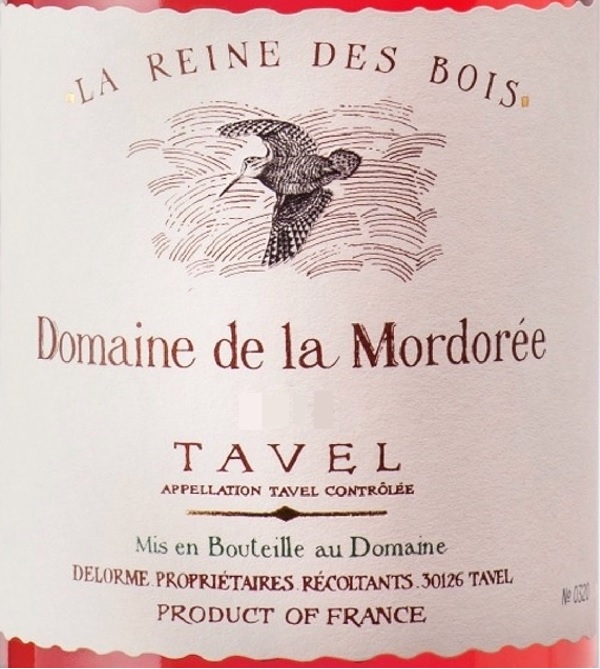
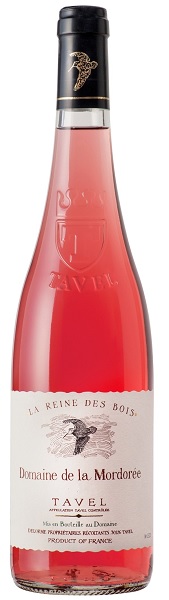
Mordoree Tavel Rose Reine des Bois is made from 60% Grenache, 15% Clairette, 10% Syrah, 10% Cinsault, 5% Bourboulenc (biodynamically farmed on a rocky/sandy plateau over clay).
This wine comes from a parcel planted on a pebbled soil covered with stones, whose geology is typical of the grands crus from the Rhone Valley (a base made of marine molasse from the Miocene period covered with an alpine diluvium from the Villafranchian period). 100 % destemming, cold maceration during 48 h., pneumatic pressing, fermentation at 18° C.
To pair with: roasted and or spicy chicken, duck, goose, fish soup, white meat, seafood and a lot of fishes (tuna, John Dorry, red mulet, etc...).Quite all Asian cuisine. Dishes with garlic, dishes with tomatoes.
In the glass the wine is deeply colored pink, almost orange/salmon. Complex aromas of white flowers, raspberry, pomegranate, strawberry, minerals, and citrus rise from the glass. Palate is full-bodied and voluptuous yet retains elegance while delivering great fruit intensity balanced by minerals and citrus. Light tannins appear mid-palate and carry through to the finish, giving it serious structure. Fresh, complex, and very long on the finish. Overall, powerful, textured, and food-driven — a “serious” Tavel that can age 1–5 years. Best enjoyed from June/July 2026 onward.
Review:
-Robert Parker The Wine Advocate 93 Points

Mordoree Chateauneuf-du-Pape La Reine des Bois is made from 80% Grenache, 10% Mourvèdre, and the rest equal parts Syrah and Vaccarèse .
This premium cuvee - whose name means "Queen of the Woods" - is from 65-year-old vines, planted on Villafranchian-era terrasses. Yield is 30 hl/ha.
Deep ruby red; opaque. Aromas of red fruits change to wooden touches of leather, black truffles and coffee. Fat, concentrated and full flavored with a very long liquoriced and fruity finish.
Review:
The 2022 Châteauneuf du Pape Cuvée De La Reine Des Bois is based on 75% Grenache, 10% each Syrah and 10% Mourvèdre, and the rest Counoise and Vaccarèse. It's not massive yet just exudes class and elegance, with both red and black fruits that give way to more spice, peppery garrigue, and leather, with classic background licorice and black olive notes. Medium to full-bodied, beautifully balanced, and elegant, with silky tannins, this brilliant Châteauneuf du Pape will evolve for two decades.
Number 36 in Dunnuck's Top 100 and 97 Points
"Huge and powerful, but so fresh. This has great driving intensity, with even bigger, more structural tannins than the domaine’s other cuvée. A rampaging Châteauneuf that will take time to settle, and will always be wild. Long, vibrant and chiselled. An absolute beast. Mordorée has been massive but overripe in the past; it's still massive but with this vintage the ripeness is more controlled, and it has transformed into something extraordinary. Fermented and aged 80% in stainless steel, the rest in old barrels. - Matt WALLS"
- Decanter Magazine (September 17th 2023, Part of Châteauneuf-du-Pape 2022: Report and top-scoring wines), 98 pts

Mordoree Lirac Rouge Reine des Bois equal parts Grenache, Syrah and Mourvedre
Color : deep dark red, with blueish hints.
Aromas : highly fruity ( raspberry, billberry, blackberry ), floral (violet) and intense with a grilled touch ( coffee ).
Palate : melted and concentrated tannins, full bodied, very long fresh finish.
Ageing potential : 8 to 10 years
Grilled meats, sauce meats, game birds, game rabbits and semi-mature cheeses.
Review:
-Jeb Dunnuck 93 Points
Mordoree Chateauneuf-du-Pape La Reine des Bois is made from Grenache 75 %, Mourvèdre 10%, Syrah 10 % , Counoise 3% & Vaccarese 2%.
This premium cuvee - whose name means "Queen of the Woods" - is from 65-year-old vines, planted on Villafranchian-era terrasses. Yield is 30 hl/ha.
Deep ruby red; opaque. Aromas of red fruits change to wooden touches of leather, black truffles and coffee. Fat, concentrated and full flavored with a very long liquoriced and fruity finish.
Pairs with red meats, sauce dishes, game animals (woodcock, wild boar) and semi mature cheeses.
Review:
-Decanter Magazine 98 Points

Mordoree Lirac Blanc Reine des Bois is made from Grapes : Grenache 35 % Clairette 25 % Viognier 10 % Roussanne 15 % Marsanne 10 % Picpoul 5%>
Color : green gold
Aromas : white fruits, peach, apricot, pear, violet.
Palate : rounded, long finish, highly flavoured.
Ageing Potential : 4-5 years.
Surface : 4 Ha. Yield : 35 Hl./Ha. Vineyard age : 30 years Terroir : Clay / chalk with pebble stones. Harvest : by hand Vinification : skin maceration and direct pressing with temperature control. Fermentation : oak barrel fermentation for 25% of the total volume
Pairs well with appetizers, fish, seafood.
Review:
-Wine Enthusiast 92 Points
Mordoree Chateauneuf-du-Pape La Reine des Bois is made from 80% Grenache, 10% Mourvèdre, and the rest equal parts Syrah and Vaccarèse .
This premium cuvee - whose name means "Queen of the Woods" - is from 65-year-old vines, planted on Villafranchian-era terrasses. Yield is 30 hl/ha.
Deep ruby red; opaque. Aromas of red fruits change to wooden touches of leather, black truffles and coffee. Fat, concentrated and full flavored with a very long liquoriced and fruity finish.
Review:
"Vinified from certified biodynamic grapes, the 2023 Châteauneuf-du-Pape La Reine des Bois brings forth ripe black fruits, fresh strawberry, pencil shavings and a floral lift of orange blossom. Full-bodied, round and concentrated, the 2023 is framed around polished tannins and maintains energizing freshness all the way through to the long, complex finish. Delicious - Nicolas GREINACHER"
- Vinous (Châteauneuf-du-Pape 2024: Dark Elegance ; Oct 2025), 93 pts
Mordoree Tavel Rose Reine des Bois is made from Grenache
Nose: Steady rose, brilliant and cristal clear.
Aromas : very complex : from flowers, white fruits and red fruits (strawberries, pomegranate, rapsberry). Slightly mentho-lated
Palate : fresh, classy, elegant, very long.
Aging capacity : 8 to 10 years.
This wine comes from a parcel planted on a pebbled soil covered with stones, whose geology is typical of the grands crus from the Rhone Valley (a base made of marine molasse from the Miocene period covered with an alpine diluvium from the Villafranchian period). 100 % destemming, cold maceration during 48 h., pneumatic pressing, fermentation at 18° C.
To pair with: roasted and or spicy chicken, duck, goose, fish soup, white meat, seafood and a lot of fishes (tuna, John Dorry, red mulet, etc...).Quite all Asian cuisine. Dishes with garlic, dishes with tomatoes.
Review:
-Robert Parker's Wine Advocate 93 Points
The Mordoree Estate
This is arguably the top estate in our Portfolio. Domaine de la Mordoree (woodcock), located in the town of Tavel, in the Southern Rhone Valley, is the most consistent producer of top quality wine in my entire selection. In 1986, the brothers Christophe and Fabrice Delorme decided to dedicate themselves to their passion for wine. They started their own estate with the objective to produce the best wines in each appellation while preserving the environment
The Mordoree Vineyard
The vineyard consists of 55 hectares (135 acres), on 38 different parcels, which provide with a rich, wide range of soils and climates. The soil is a mix of clay, chalk and sand with pebble stones. The improvements at the Domaine have been incredible: new pneumatic presses, new stainless steel vats, new destemmer, new vinification and aging plant, and aging in oak barrels for the top wines. All the grapes are raised by culture raisonnée which is very close to organic viticulture (intervention in the vineyard only when necessary). The yield is reduced in the vineyard by ébourgeonnage (de budding in spring) and vendanges vertes in summer (green harvesting). Oak aging for the top wines in special barrels like “jupille” for 10 months. No expense is spared at this Domaine to achieve quality.

Alejandro Bulgheroni Lithology Beckstoffer Las Piedras Cabernet Sauvignon is made from 100 percent Cabernet Sauvignon.
From a St. Helena vineyard planted by early Napa settler Edward Bale more than 150 years ago, and later serving as the estate vineyard for the area’s first winery built by Henry Pellet in 1860, the Las Piedras site always gives us our prettiest wine. When placed next to Dr. Crane and To-Kalon wines, the Las Piedras show a certain elegance, with a very graceful entry and finely detailed complexity. We produce it with at least 75% new French oak, so there is a floral, spicy, and vanilla accent to the intense red and black fruits, cassis, and black cherry liqueur. What distinguishes this bottling is the beautifully fine tannins, delicate texture, and stunning purity. (Less than 100 cases made.)
Fermentation 70% Oak, 24% Concrete, 6% Puncheon
Review:
-Jeb Dunnuck 98 Points

Gap's Crown Vineyard has become one of the most iconic Pinot noir vineyards in the Sonoma Coast. It was originally developed by Premier Pacific Vineyards between 2002 and 2005 and later purchased by Price Family Vineyards in 2013. In 2007, Sojourn Cellars became one of the best to make a vineyard-designate wine from Gap's Crown. Our clone 115 block, planted in 2005 on 3309 root stock at 800 feet elevation, has been the foundation for Sojourn since we began making Pinot noir from this vineyard. Our clone 828 block was planted in 2002 on 420A root stock, and two clone 667 blocks round out the blend, both planted in 2004 on 3309 root stock. This hillside vineyard is situated on the western slope of Sonoma Mountain and is cooled by the persistent wind and fog of the Petaluma Gap.
WINEMAKER NOTES: The 2021 growing season offered optimal conditions in the Sonoma Coast to harvest grapes of exceptional quality. The air remained clear with no res in Sonoma and pandemic lock downs ended. Our spirits were lifted and the grape harvest and wine quality benefited. . Brief heat waves in August and September ripened the grapes to ideal maturity as the weather stayed dry until major rains arrived October 22, after our grapes were harvested. Yields were lower than average in 2021, with small berries and loose clusters creating wines of increased depth and concentration. In 2021 we blended destemmed clone 115 and clone 667, while fermenting all the clone 828 100% whole-cluster. The resulting wine, our 15th vintage of Pinot noir from Gap’s Crown Vineyard, offers complex layers of elegant fruit flavors with a bold strength at its core.
Review:
-International Wine Report 97 Points

Kershaw Smugglers Boot Pinot Noir is made from 100% Pinot Noir made from French clones PN667, PN115 and PN113.
The name derives from the time of trade embargoes in South Africa when growers & winemakers smuggled grapevine material into the country by hiding the cuttings in Wellington boots. The Smuggler’s Boot range celebrates that ingenuity.
Attractive strawberry, savory and star anise spice linger on the nose. Juicy and sumptuous on the mid palate with breadth of flavor offset by a nimbleness of fresh acidity, friable tannins and sinuous mouthfeel, this Pinot unwraps to earthy, fennel, chocolate and a hint of incense to a long supple finish.
Handpicked grapes were first bunch sorted on a conveyor before the stems were removed and the destemmed berries sorted to remove jacks and substandard berries. After a 3-day maceration in 500kg open-topped fermenters, the uncrushed grapes began a spontaneous fermentation. A gentle pigeage program was charted and the grapes remained on skins for 10-16 days.
The free-run wine was racked to a combination of 50% French oak barrels (10% new) and 50% breathable plastic eggs with the remaining pomace basket-pressed. Malolactic then proceeded followed by a light sulphuring after which the wine was racked off Malolactic lees and returned to cleaned barrels for an 11-month maturation. No finings, simply racked and light filtration prior to bottling.
Richard Kershaw’s personal suggestions for dishes include charcuterie, its salt and fat being complemented by the delicate spicy notes and fruit; Pork loin with honey, pepper, and lemon-zest glaze; Carpaccio; duck cassoulet; ovenroasted monkfish with garlic mashed potatoes; seared tuna; wild mushroom risotto; a simple beet salad with some hazelnuts and ricotta cheese; a slice of Brie or Gorgonzola dolce.

I feel this wine expresses the greatness of California and its hidden pockets where Cabernet can excel. The cold Pacific Ocean running the entire length of the state presents maritime influences – and with each small distance eastward the climate warms. Stony soils, south facing slopes and moderately warm conditions are the keys to producing dark, rich and good tasting Cabernet.
A small release from Caymus Vineyards, this wine is a California-appellation Cabernet Sauvignon – supple, dark and rich, bearing the signature hallmarks of Caymus. It is sourced from sites throughout the state which feature climatic conditions, soils and topography that are ideally suited to Cabernet. This project stems from excitement over California's diverse vineyard land, often in lesser-known areas, with the potential to produce exceptional Cabernet.

DAOU Vineyards Reserve Cabernet Sauvignon is made from 77% Cabernet Sauvignon, 23% Petit Verdot.
The 2021 DAOU Reserve Cabernet Sauvignon is emblematic of Paso Robles as a world-class region for Bordeaux-style wines. Intense purple-red hues foreshadow deep aromas of black fruit, pomegranate, tobacco, mocha, and bay leaf. Trailing notes of clove, nutmeg, and vanilla emerge as the wine opens up in the glass. Opulent textures expand across the palate with flavors of red fruit, blueberry, and chocolate-covered raspberry. The overall experience is fresh and rich, concluding with velvety tannins and impressive length.
Review:
-Wine Enthusiast 95 Points

Charles Krug Peter Mondavi Family Vintage Selection Cabernet Sauvignon is made from 100 percent Cabernet Sauvignon.
Review:
-Wine Advocate 95 Points

Pahlmeyer Jayson Red Napa Valley is made from 51% Merlot, 27% Cabernet Sauvignon, 11% Malbec, 7% Petit Verdot, 4% Cabernet Franc.
Voluptuousness meets vibrance in this classic Bordeaux-inspired blend. Ripe Merlot-dominant aromas of juicy macerated raspberry unfurl with hints of pencil lead, clove, cedar, and fresh sage. The compact fruit core, flanked by fine, polished tannin, surges open on a full, silky palate, giving way to complex underpinnings of earth and spice. A beam of bright acidity keeps the fruit fresh and focused through a soft, lingering finish of dusty plum and cocoa.
It’s best to serve this rich, layered wine at a temperature between 60°F and 65°F. Open and opulent in its youth, this wine is ready to match with a range of flavorful summer dishes such as Carolina-style pulled pork, bánh mì sandwiches, or bacon cheddar burgers.
Review:
This is a very polished wine in 2022, well-built with neatly knit tannins that form a solid foundation for the dark currant and blackberry fruit that floods the mid-palate. Good depth of concentration and driving energy create a sense of tension and vibrancy. Indeed not a shy wine, yet more approachable, with tannins almost melting away on the finish—very characteristic of the warm vintage. Grape sources include William Hill and Broken Rock in Napa, Stagecoach, Waters, and Round Pond in Rutherford, along with Cabernet Franc and Cabernet Sauvignon from the iconic Monte Rosso Vineyard in Sonoma. Grapes are sorted by hand, fermented in stainless steel with a small percentage in oak tanks, and then aged for 15 months in 80% new French oak. (JC)
-Decanter 94 Points

Textbook sources its 'Mise en Place' Cabernet from Oakville, one of Napa Valley's most prestigious appellations, prized for its deep, diverse soils. A blend of 92% Cabernet Sauvignon and 8% Merlot, it delivers Oakville's hallmark of dark fruit, cedar and silky tannins at a price that over-delivers.
Review:
This wine succeeds from its sense of place: Oakville, with its diverse soils and reputation as being a premier location for grape-growing in Napa Valley. The wine, 92% Cabernet Sauvignon and 8% Merlot, opens with daunting notes of charred cedar, blackberry, bittersweet dark chocolate, and umami. Silky tannins envelop the back of the palate, with cherrywood and fleshy purple fruit integrated into its powerful — yet luxurious — conformation.
The Tasting Panel 96 Points