
" We don't sell the wine without touching the vine "
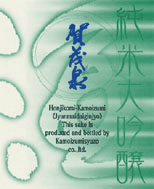
| Country: | Japan |
| Region: | Saijo |
| Winery: | Kamoisumi Brewing Company |
| Grape Type: | Yamada Nishiki (Sake) |
| Vintage: | NV |
| Bottle Size: | 500 ml |

This Junmai Daiginjo has a beautiful nose full of banana, melon and star anise. The all natural brewing process gives this sake a bright fresh palate of plum, lime and minerality with a clean dry finish. A very food friendly sake, and is thought to be best after the meal with a light, smooth, rich cow's milk cheese.
POLISHING RATIO: 40%
ALCOHOL: 16-17%
SMV +/-: +1.0
ACIDITY: 1.2
RICE KOJI: HATTANISHIKI
RICE KAKE: HATTANISHIKI
YEAST STRAIN: PROPRIETARY YEAST
FOOD PAIRINGS: Poached Lobster, Seared Scallops, Tofu, Steamed Dumplings
CHEESE PAIRINGS: Brillat Savarin, Cambozola, Dulce Latte Gorgonzola, Mimolette

Juicy & Refreshing. Full of fruity flavors with clean sweetness. Brewed with Hitogokochi, the special sake rice harvested in Nagano, and natural water slowly filtered down the Japan Alps. In 1866, toward the end of the Edo period, Matsujirou Kurogouchi and his family started a small sake brewery currently called Senjo named after Senjo Ga Take, a 3000-meter peak in the Japanese Alps. Today Senjo Brewery strives to combine art with science and old skill with new technology by adding modern twits to the rich historical traditions of Sake brewing.
Pair with Deep-fried fish with sweet & sour sauce, Young sweetfish tempura (chiayu tempura), Caesar salad.
Juicy & Refreshing. Full of fruity flavors with clean sweetness. Brewed with Hitogokochi, the special sake rice harvested in Nagano, and natural water slowly filtered down the Japan Alps. In 1866, toward the end of the Edo period, Matsujirou Kurogouchi and his family started a small sake brewery currently called Senjo named after Senjo Ga Take, a 3000-meter peak in the Japanese Alps. Today Senjo Brewery strives to combine art with science and old skill with new technology by adding modern twits to the rich historical traditions of Sake brewing.
Pair with Deep-fried fish with sweet & sour sauce, Young sweetfish tempura (chiayu tempura), Caesar salad.
Juicy & Refreshing. Full of fruity flavors with clean sweetness. Brewed with Hitogokochi, the special sake rice harvested in Nagano, and natural water slowly filtered down the Japan Alps. In 1866, toward the end of the Edo period, Matsujirou Kurogouchi and his family started a small sake brewery currently called Senjo named after Senjo Ga Take, a 3000-meter peak in the Japanese Alps. Today Senjo Brewery strives to combine art with science and old skill with new technology by adding modern twits to the rich historical traditions of Sake brewing.
Pair with Deep-fried fish with sweet & sour sauce, Young sweetfish tempura (chiayu tempura), Caesar salad.

Sake Eikun Junmai Ginjo Water Lords 12/720ml is made with Iwai rice.
Eikun sake uses water from a source called "Fusui", rated as one of the top 100 sources of water in Japan. This water source is located just south of the ancient Japanese, and still cultural capital of Japan, Kyoto.
Aromas of macadamia oatmeal cookie, spicy zucchini bread, and vanilla cream with a satiny fruity-yet-dry medium-to-full body and a layered, banana custard, jicama, salted whole nut, apple, and radish nuanced finish. A Wonderfully vibrant and flavorful sake.-Beverage Tasting Institute 94 points (Exceptional)
RATING: 94 points (Exceptional)
CATEGORY: Junmai Ginjo Sake, Sake
ALCOHOL BY VOLUME: 15.3%
TASTING LOCATION: In Our Chicago Tasting Room
TASTING DATE: Dec-05-2012
WINE ID: 200768
Made with Iwai rice.
Eikun sake uses water from a source called "Fusui", rated as one of the top 100 sources of water in Japan. This water source is located just south of the ancient Japanese, and still cultural capital of Japan, Kyoto.
Rice milling: 60%

Sake Eikun Junmai Ginjo Water Lords is made with Iwai rice.
Eikun sake uses water from a source called "Fusui", rated as one of the top 100 sources of water in Japan. This water source is located just south of the ancient Japanese, and still cultural capital of Japan, Kyoto.
Aromas of macadamia oatmeal cookie, spicy zucchini bread, and vanilla cream with a satiny fruity-yet-dry medium-to-full body and a layered, banana custard, jicama, salted whole nut, apple, and radish nuanced finish. A Wonderfully vibrant and flavorful sake.-Beverage Tasting Institute 94 points (Exceptional)
RATING: 94 points (Exceptional)
CATEGORY: Junmai Ginjo Sake, Sake
ALCOHOL BY VOLUME: 15.3%
TASTING LOCATION: In Our Chicago Tasting Room
TASTING DATE: Dec-05-2012
WINE ID: 200768
This smooth, full-flavored sake possesses a rich range of flavors, from persimmon to caramel to earthy notes of mushroom and loam. Tartness, sweetness and shibumi (astringency) all converge in full-bodied balance. Kamoizumi's combination of mild sweetness and robust flavor make it a good match for Vietnamese cuisine as well as rich seafood dishes like miso-marinated cod. Serve at 55 degrees, or bring to room temperature for a sweeter sake experience.
Rice Variety: Yamadanishiki
Polishing Ratio: 50%
Alcohol Percentage: 16.0%
Sake Meter Value: +0.5
Acidity: 1.4
Yeast Type: Setouchi 21
The Kamoisumi Brewing Company Brewery
From December through March, the Saijo area west of Hiroshima has an average temperature of 38 degrees Fahrenheit with low humidity. The water is mildly alkaline. The rice is good. It is one of the most favored brewing locales in the entire Japanese archipelago.
The Maekake family, who run the Kamoizumi brewery, started out as rice farmers who became landlords and then moved into "value added" areas such as rice milling and eventually sake brewing at the onset of the modern era in 1910. In 1965, Kamoizumi became one of a pioneering group
of ten breweries who committed to junmai sake production at a time when breweries all over Japan were heavy-handedly adding brewers alcohol to their vats to make as much money as possible.
In 1971, Kamoizumi introduced its first junmai label. At the time, it was the practice to filter the pressed sake through charcoal to remove impurities and attain the pure, colorless state that was the aesthetic ideal. The Kamoizumi brewers felt, however, that these "impurities" were essential characteristics of the sake itself and that to remove them entirely was to compromise the essential nature of its identity.
No brewery in Japan has taken a stronger stand for individuality than Kamoizumi. Their sake has an attitude: robust, tawny, full-flavored, yet with the smooth finish and easy drinkability that
are the hallmarks of technical mastery. Aging and blending are paramount, and when finally released, the Kamoizumi labels pair well with meat dishes and Chinese cuisine, a rarity in the sake world. For the connoisseur, their supple balance of sweetness, acidity, astringency and the elusive flavor component of "umami" is without peer.
Sake Eikun Junmai Ginjo Water Lords is made with Iwai rice.
Eikun sake uses water from a source called "Fusui", rated as one of the top 100 sources of water in Japan. This water source is located just south of the ancient Japanese, and still cultural capital of Japan, Kyoto.
Aromas of macadamia oatmeal cookie, spicy zucchini bread, and vanilla cream with a satiny fruity-yet-dry medium-to-full body and a layered, banana custard, jicama, salted whole nut, apple, and radish nuanced finish. A Wonderfully vibrant and flavorful sake.-Beverage Tasting Institute 94 points (Exceptional)
RATING: 94 points (Exceptional)
CATEGORY: Junmai Ginjo Sake, Sake
ALCOHOL BY VOLUME: 15.3%
TASTING LOCATION: In Our Chicago Tasting Room
TASTING DATE: Dec-05-2012
WINE ID: 200768

Saumaize Michelin Pouilly Fusse Premier Cru La Marechaude is made from 100 percent Chardonnay.
A beautiful Pouilly-Fuisse from "La Marechaude" parcel that Saumaize-Michelin acquired in 2013. Planted on clay and limestone slopes and hand harvested, this Chardonnay offers fresh and elegant notes of white flowers, crisp, citrus and exotic fruits. Powerful and mineral on the palate with a fantastic balance, finesse and freshness. The exceptional terroir brings minerality and juicy flavors of stone fruits, peach and melon supported by subtle toasty notes.
It is now a Premier Cru.
Jasper Morris - Inside Burgundy 94 Points

Jean Reverdy Sancerre Blanc is 100% Sauvignon Blanc
Single vineyard. Vinification: cold fermentation in stainless steel tank, no oak, no malolactic fermentation.
Sweet, fruity and clean. White flowers (acacia, jasmine) and citrus fruits aromas. Perfectly balanced.
A delicious wine, perfect with fish dishes, especially salmon, and a local goat cheese Crottin de Chavignol.



