" We don't sell the wine without touching the vine "

San Giorgio Ugolforte presents a dark core of red and black berry fruit layered with earth, leather, smoke, and herbs. Complex and elegant, the wine is full on the palate and firm in tannin structure. Refreshing acidity frames a graceful finish. Classic Brunello di Montalcino.
This red is marked by cherry, plum, thyme, sage and loam aromas and flavors. Lively and firmly structured, featuring a saline undercurrent. An open-knit version, with nice equilibrium, fine energy and a long, resonant finish.
-Jeb Dunnuck 94 Points
-Wine Spectator 94 Points

Kershaw Syrah Deconstructed Lake District Cartref SH22 is made from 100 percent Syrah.
The inspiration for this Syrah stems from my belief that the Elgin region has both a signature grape as well as particular terroirs within its demarcated boundary that reflect regional credentials. This Syrah was selected from a sub-region of Elgin from a specific vineyard and an individual clone.
Sourced from a single parcel in the Western part of Elgin, the 22 clone produces fuller, well-colored yet finely structured wines. They tend to be more concentrated as yields are low with more black fruit, black pepper and meaty notes. The Cartref soils, a mixture of decomposed sandstone, pebbles and quartz, add gracefulness and heighten the fruit intensity.
The grapes were handpicked under autumnal skies into small lug baskets and then manually sorted on a conveyor before the stems were removed. The destemmed berries fell onto a vibrating table in order to remove jacks and substandard berries before dropping uncrushed into a small 500kg conical hopper and forklifted into open-topped fermenters. The grapes underwent a 3-day maceration before spontaneous fermentation began. A gentle pigeage (punch-down of the cap) program was charted and the grapes remained on skins for 26 days. The wine was then racked to barrel under gravity and the remaining pomace basket-pressed. Malolactic then proceeded in barrel followed by a light sulfuring and 17-month maturation. No finings were necessary and the wine was simply racked and bottled unfiltered.
Review:
"The 2017 Kershaw Deconstructed Lake District Cartref SH22, matured 50% in new oak for 17 months, is a little more open on the nose compared to the SH9c and delivers a touch more red berry fruit, quite candied in style and suggesting strawberry pastilles. The palate is medium-bodied with a saline entry, fine definition and a mélange of red and black fruit laced with licorice toward the poised finish. Excellent.- Neal Martin"
- Antonio Galloni's Vinous (April 2021), 93 pts

Castellare di Castellina 'I Sodi di San Niccolo' Toscana IGT is a blend of Sangioveto (85%-90%) and Malvasia nera (15-10%)
Castellare’s top wine, ranked in the Wine Spectator Top 100 on multiple occasions and recognised with the prestigious Gambero Rosso’s Tre Bicchieri and Bidenda’s Cinque Grappoli ratings. The company takes great pride in demonstrating the greatness of the Sangioveto variety, paired with Malvasia Nera, achieving a worldwide position of sixth place.
Pairs well with cold cuts and meat rich in flavour, cheeses with a strong and aromatic taste, in particular, Pecorino Toscano and Parmigiano.
The masterpiece of Castellare, I Sodi di San Niccolo, has twice placed in the top 100 of Wine Spectator, and has been awarded “Three Glasses” by Il Gambero Rosso.
I Sodi di San Niccolo is produced solely with native varieties: 85-90% of Sangioveto and 10-15% of Malvasia Nera, I Sodi comes from the two best crus of the farm.
The word "I Sodi" was used by the Tuscan farmers to describe those grounds which had to be processed by hand, being too hard (in fact firm) or too steep to allow for the employment of the horses, unlike the "fields" that make the grounds more easily cultivable.
Reviews:
Clear ruby with a fine garnet sheen. Impressive nose, very finely drawn, aromas of juicy cherries, blood orange and dried thyme, some liquorice in the background. Polished and precise from the attack to the finish, finely-meshed, very well-integrated tannins, flows beautifully, finely worked out fruit, long finish.
-Falstaff 97 Points
Complex and deeply embedded aromas of ripe blackberries, spices and aromatic bark. Full-bodied and very firm for now, with impressive concentration of fruit and tannin. Very long, balanced finish. Great to taste now, but this is one for the cellar. Patience will be rewarded. Sangiovese and malvasia nera. This has always been a top Tuscan red. Best from 2027.
- James Suckling 96 Points
Super fragranced nose, patchouli, pot pourri, Turkish Delight, rose with caramelised red berries and a touch of smoke and incense - all quiet forward and expressive. The nose alone you could smell for hours such is its complexity and beguiling nature. Powerful and concentrated on the palate, this is broad and muscular, sinewy with depth and determination. Tannins are well integrated, really giving the support to the fruit and acidity, driving the flavours forward despite the clear weight and hold. Fragranced red berries continue on the palate with a touch of stone, graphite and matchstick. Rich and big on the mid palate, becoming more focussed towards the finish. Cleary well made with lots going on. Acidity is great, it's cool, clean, sleek and packed full of flavour. Almost too much, this is a big wine, so needs time, but has lots of appeal and mouthwatering freshness throughout. Released on the 9th March. Director and winemaker Alessandro Cellai.
- Decanter 96 Points

Poggio San Polo Podernovi Brunello di Montalcino is made from Sangiovese.
Intense ruby red in color with garnet hues, clear and glossy. The bouquet exhibits typical aromas of violets and small red berries. Subtle nuances of forest undergrowth, aromatic wood, a touch of vanilla and jammy mixed fruit then give way to subtle hints of coffee. This Brunello is intense, persistent, broad and heady. Full-bodied and warm on the palate, with a densely-woven texture and robust body, it has a persistent finish with well-rounded tannins. The particular features of the terroir at San Polo produce a Brunello with a capacity for lengthy aging, while patient cellaring enhances the wine during ageing in the bottle.
Review:
Lovely purity of fruit with ultra fine tannins and depth, finesse and complexity. Black cherries, cedar and some flowers. It’s full-bodied with very fine tannins that drive the finish. Give it a year or two to open more, but already so enticing. Drink or hold.
-James Suckling 96 Points
The San Polo 2015 Brunello di Montalcino Riserva (with 8,000 bottles produced) is a textured wine with hearty fruit and touches of smoked meat and spice. At its core, the wine offers dark fruit, blackberry and ripe plum. The rich fruitiness of the wine cedes to campfire ash, mahogany and furniture wax. These results are sultry and even a bit flashy, with distant background tones of teriyaki and plum sauce. The wine is fermented in cylindrical oak fermenters and aged in oak for three years. We'll see this bottle hitting the market sometime after February 2021.
-Wine Advocate 95 Points

The 2017 Brunello has certainly enjoyed the benefits of a careful selection in the parcels (including the Millecento vineyard). The wine has a wide nose. It maintains crisp fruit and floral notes. In the mouth it is elegant, complete and supported by an excellent acidity.
Review:
Aromas of ripe berries and plums with some flowers and nutmeg follow through to a full body with round tannins and a juicy finish. Slightly chewy, but friendly and succulent. Excellent 2017, despite the dry growing season.
-James Suckling 94 Points

A ruby red garnet color, ripe fruit aromas, dried fruits, hints of licorice and scents of vanilla. Robust and harmonious in the mouth, a rich texture. The wine is only produced in the best vintages.
The grapes are coming from a vineyard planted at 400 meters above sea level. The soil is mainly marl and limestone.
The density of vines per hectare is 5,000 plants, which is equivalent to 2,000 vines per acre.
The pruning technique used is cordon
The grapes used are 100% Sangiovese grosso
Alcoholic fermentation was done in tank, while the Malo-Lactic fermentation was carried in oak barrels.
Wine was then aged for one year in big French oak barrels and 3 years in Slavonian oak barrels.
Review:
Rich and very slender in the sensory profile alternating notes of black prunes, blackberries, sandalwood, incense, camphor, withered white flowers and vetiver. Hints of woodland undergrowth animate the secondary scene giving it a dark character. Full bodied, soft tannins and a solidly performing finale. Better from 2024.
Raffaele Vecchione - WinesCritic.com 93 Points
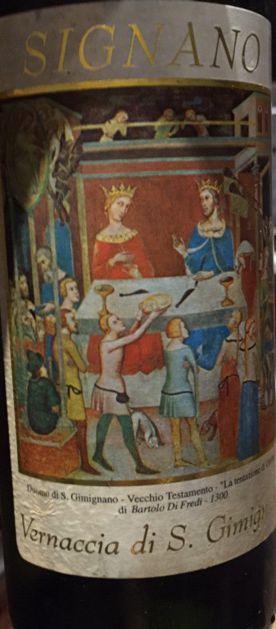
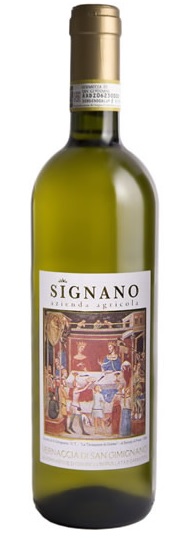
Because of Vernaccia di San Gimignano’s ancient tradition and unquestionable quality, it was the first white wine to be awarded D.O.C. recognition in 1966. Since 1993 the Vernaccia S. Gimignano has entered into the category of D.O.C.G. Recognition, that means Denomination of Origin Controlled and Guarantee.
Appellation: Tuscany
Composition: 100% VernacciaTasting Notes: Intense straw yellow color with golden highlights. Fruity and flowery aromas with essence of apple and almond. Dry, warm, quite soft with lemon flavors accented by a nutty texture that revels itself in the finish.
Pairing: This wine is a perfect companion to appetizer, poultry, seafood and cheese.
Soil: Clay - limestone - silicon
Vinification: Stainless Steel Fermented
Signano Estate
San Gimignano rises on a hill 384 mt high and dominates the Elsa valley with the skyline of its 13 towers. The Manhattan like sky scrapers were built between the 12 and the 13th century. Not unlike today, the towers were a symbol of the economic powers of the noble families of that region.The Vernaccia vine has been growing in the charming hillsides which surround this middle-age town since 1200 ad. This is the vine for the production of Vernaccia di San Gimignano, which for centuries has tempted popes, honored magnificent feasts of the renaissance princes, and has won a growing fame over time.
Because of Vernaccia di San Gimignano’s ancient tradition and unquestionable quality, the wine was the first to be awarded DOC recognition in 1966. Since 1993 the Vernaccia di San Gimignano has entered into the category of DOCG recognition. The Signano Estate began its activity in 1961, when the Biagini Family purchased a small plot of land of 4.5 Ha. in Signano. Prior to the planting of his first vineyard in Vernaccia, Ascanio earned a reputation as bailiff to a land-owner from Florence where he maintained a broad reputation for his knowledge of the vineyards and wines of the region. The first cellar was built in 1966 and the lands adjacent to it were purchased in the following years for vineyards.
The leased vineyards and olive groves create the present Estate that covers approximately 30 Ha. Most of the Estate is cultivated with Vernaccia, but 3 Ha. are dedicated to the production of Vin Santo (dessert wine) and 6 additional Ha. are used for the production of extra virgin olive oil. Today, the cellar has a capacity of 205,000 litres with an additional ninetyfive 100 litre oak casks for the maturation of Vin Santo.

Joseph Phelps Vineyards Cabernet Sauvignon is made from 92% Cabernet Sauvignon, 4% Petit Verdot, 2% Cabernet Franc, 1% Merlot, 1% Malbec.
A classic Napa Valley Cabernet Sauvignon with inviting violet, dark fruit, tobacco, subtle baking spice and earthy dried herb aromatics. The palate is filled with expressive black cherry, blackberry and dark plum, hints of spice box and sweet vanilla bean. A focused, concentrated wine with youthful energy and freshness nimbly balanced by supple tannin structure and finesse.
Review:
Blackcurrants, spiced cedar and dark spices with bark undertones. Full-bodied with very fine, velvety tannins. Textured and compact with a firm, lingering finish. Tight at the end. Needs time to open.
-James Suckling 94 Points

Demoiselles Sancerre Blanc is made from 100 percent Sauvignon Blanc.
The name "Les demoiselles" (translate as "The young ladies"), refers to the beautiful migratory birds (Cranes) that fly over the town of Sancerre twice a year (in the Fall going South to spend the winter in the African continent, and in the Spring going back North to spend the Summer in Northern Europe). These graceful birds offer a unique and impressive show when they sometimes land on the banks of the Loire River. The Fleuriet family wanted to highlight this exceptional grace and express an elegant and refined bouquet in this Sancerre Demoiselles cuvée.
The wine shows a bright yellow color with green highlights, a fruity nose with aromas of white flowers and acacia. Light-medium bodied in the mouth, supple and well structured, its concentration and crisp acidity make it a harmonious and food-friendly wine.
Pairs nicely with fresh goat cheeses, oysters with lemon, grilled lemon chicken breasts and Mexican dishes. Serve these whites at 46 °F (8 °C).