
" We don't sell the wine without touching the vine "
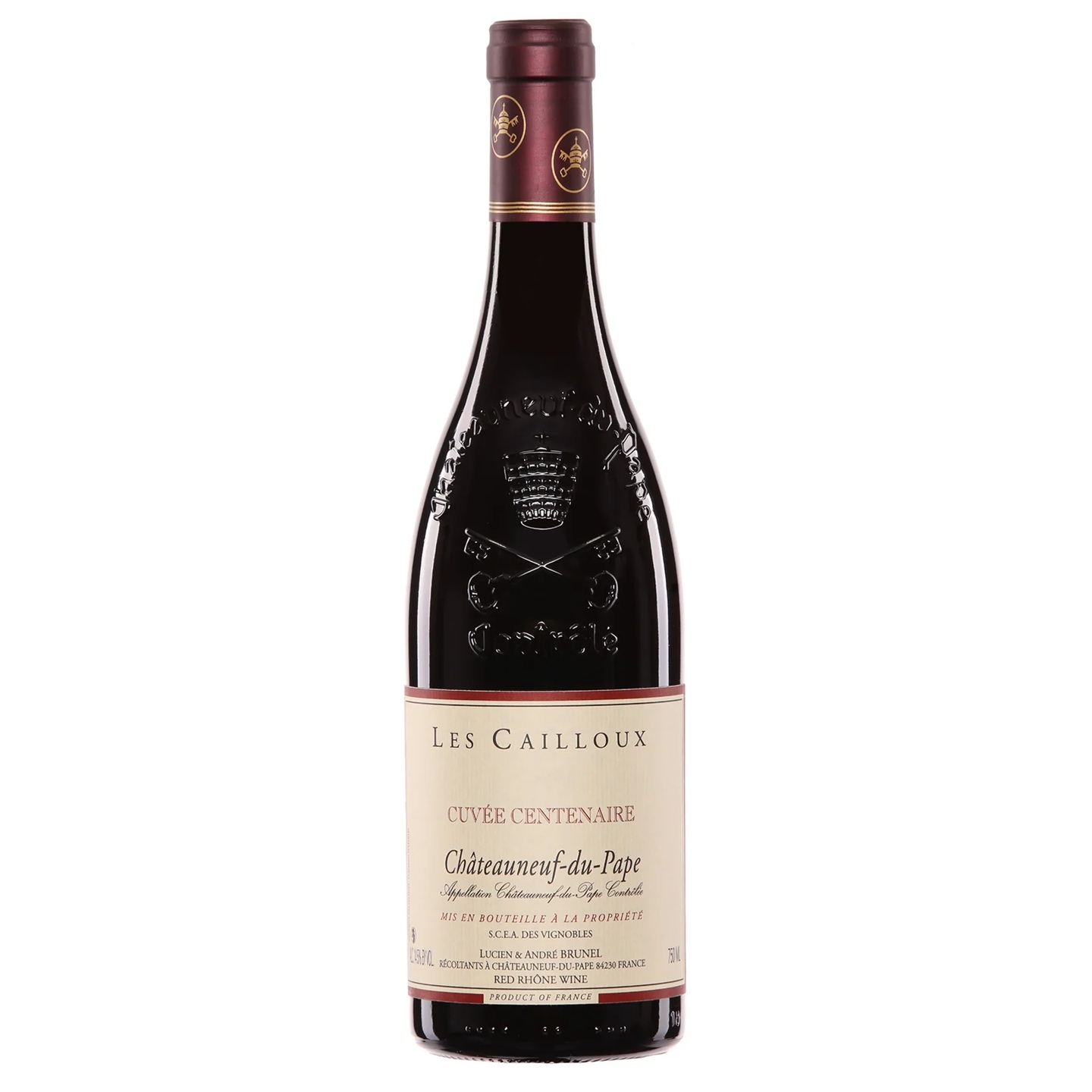
| BUY MORE! SAVE MORE! | ||||||||||||||||||||
|
| Country: | France |
| Regions: | Rhone Chateauneuf du Pape |
| Winery: | André Brunel |
| Grape Type: | Grenache |
| Organic: | Yes |
| Vintage: | 2019 |
| Bottle Size: | 750 ml |
Lucien et Andre Brunel Chateauneuf-du-Pape Les Cailloux Cuvee Centenaire is made from 84% Grenache, 10% Mourvèdre, and 6% Syrah.
Review:
-Jeb Dunnuck 98 Points
Our family has been in the Châteauneuf-du-Pape region since the 18th century and has been fully committed to making wine for five generations.
As of the 18th century, the wine-making activity of our family was testified by the purchase of a vineyard plot from the Bishop of Avignon to the north of the appellation.
Numerous generations followed on, all working in the vineyards but it was only in 1954 that Lucien Brunel created the name “Les Cailloux” to develop the business and promote the Domaine’s wine qualities and special characteristics. From that time one, it was referred to as the Domaine Les Cailloux.
In 1971, André Brunel took over the reins of the Domaine. His endless motivation resulted in a rapid growth for the Domaine: repurchasing of Côtes du Rhône and Vins de Pays vines, and launch of the infamous Centenary Cuvée in 1989. He also made some considerable changes in the vine management process by being one of the first people in Châteauneuf-du-Pape to use the ground covering method and to proceed with a non-chemical approach to wine-farming.
In 2012, his son, Fabrice Brunel, joined the team so the family history can continue.
The Estate is divided up into three appellations: Châteauneuf-du-Pape of course, but also Côtes du Rhône and Vaucluse Vins de Pays.
Our pursuit for quality, our utmost respect for the land and the drive to always provide our customers with wines they can enjoy throughout their ageing, impels us to be immeasurably meticulous during its production, regardless its appellation.
The differences are mainly the maturing times (longer for the Châteauneuf, and shorter for the Vins de Pays to make them available sooner) and the usage of vats (for Syrahs in Châteauneuf-du-Pape to mellow out the tannins, absent on the Côtes du Rhône and the Vins de Pays to maintain the fruits freshness).
We want to produce wines reflecting their region and origin while remaining elegant and wonderfully subtle.
Châteauneuf-du-Pape
The Domaine boasts 21 hectares under the Châteauneuf-du-Pape appellation, including 2 with whites, which are divided up into about ten segments. The largest are Farguerol to the north, Revès and Plan du Rhône to the south and Bois de la Ville at the top end of the village.
The soils vary with countless round pebbles but also sandy and clayey soils.
Ground topography: analysis of a segment with round pebbles
The “useful” layers for the vineyard are in tiers of about 3 metres:
Deep roots make it easier to trap water which is present over 2 metres under the surface and the pebbles reduce the evaporation due to heat or the Mistral. Therefore the plant is well hydrated even during hot summer weather.
Grape Varieties planted
The red grape varieties are mainly Grenache Noir, followed by Mourvèdre, Syrah and Cinsault:
In white grapes, Roussanne dominates (85%) followed by White Grenache (15%).

Deep red with a slight purple hue on release. The wine has a rich mix of dark chocolate infused with coffee bean and black liquorice, then scents of tar, aniseed, raw (pure) soy and black olive on the nose. The palate is expansive, and yet balanced and finessed. An amalgam of dark berried flavors and textural sensations. The 100% new oak is completely absorbed, meshed with ripe tannins, completing a palate of impressive length and youthfulness.
Parcels of fruit for this wine were identified in the vineyard by the winemakers. Daily fruit inspection led to the fruit being harvested at optimum flavor ripeness. The fruit was harvested at night and quickly transported to the winery. The fruit was destemmed to 6T open fermenters for fermentation. A Shiraz specific yeast was selected to ferment the wine and fermentation was carried out at a maximum of 28°C. The fermenter was manually pumped over twice daily in the first half of fermentation to give the winemakers control of color, flavor and tannin extraction. Pump over regimes were adjusted toward the end of fermentation to suit the tannin and flavor extraction of the wine. The cap was completely broken up on each pump over. The wine remained in fermenters for 6-8 days (dependent on parcel) before being pressed, inoculated with malolactic bacteria and filled to American oak (100% new barrels). The wine was racked post malolactic fermentation and returned to the same barrels. The wine was topped every month and after six months racked and returned to the same barrels again. Prior to bottling the parcels were emptied from oak and blended. Minimal fining and filtration was carried out prior to bottling.
Review:
-Jeb Dunnuck 96 Points
-Wine Spectator 94 Points

Mordoree Chateauneuf-du-Pape La Reine des Bois is made from 80% Grenache, 10% Mourvèdre, and the rest equal parts Syrah and Vaccarèse .
This premium cuvee - whose name means "Queen of the Woods" - is from 65-year-old vines, planted on Villafranchian-era terrasses. Yield is 30 hl/ha.
Deep ruby red; opaque. Aromas of red fruits change to wooden touches of leather, black truffles and coffee. Fat, concentrated and full flavored with a very long liquoriced and fruity finish.
Review:
The 2022 Châteauneuf du Pape Cuvée De La Reine Des Bois is based on 75% Grenache, 10% each Syrah and 10% Mourvèdre, and the rest Counoise and Vaccarèse. It's not massive yet just exudes class and elegance, with both red and black fruits that give way to more spice, peppery garrigue, and leather, with classic background licorice and black olive notes. Medium to full-bodied, beautifully balanced, and elegant, with silky tannins, this brilliant Châteauneuf du Pape will evolve for two decades.
Number 36 in Dunnuck's Top 100 and 97 Points
"Huge and powerful, but so fresh. This has great driving intensity, with even bigger, more structural tannins than the domaine’s other cuvée. A rampaging Châteauneuf that will take time to settle, and will always be wild. Long, vibrant and chiselled. An absolute beast. Mordorée has been massive but overripe in the past; it's still massive but with this vintage the ripeness is more controlled, and it has transformed into something extraordinary. Fermented and aged 80% in stainless steel, the rest in old barrels. - Matt WALLS"
- Decanter Magazine (September 17th 2023, Part of Châteauneuf-du-Pape 2022: Report and top-scoring wines), 98 pts

Xavier Vignon Chateauneuf-du-Pape Rouge Cuvee Anonyme 2019 is made from 60% Grenache, 15% Mourvedre, 10% Syrah and the rest is "field blend" with the following grapes : grenache, vaccarese, counoise, mourvèdre, terret noir and muscardin.
One of Xavier Vignon's first almost anonymous blends only in MAGNUMS !
The grapes come from "collection vines", where many grape varieties are planted together, making it difficult to identify the exact share of each variety: grenache, vaccarese, counoise, mourvèdre, terret noir and muscardin.
Partially destemmed and vinified in a mix of demi-muids and tank, it offers a beautifully pure, vibrant bouquet of black raspberries, white and black pepper, candied orange, and violets. Complex, layered, and nuanced, this beauty is medium to full-bodied, has a seamless texture, and a great finish. It has both elegance and richness, and will keep for 15+ years.
Pairing: Duck in sauce with olives. Ravioli with porcini mushrooms, cream of parsnip and bacon crisps. Partridge leg confit with olive oil.
Review:
-Jeb Dunnuck 97 Points
-Bettane et Desseauve 94 Points

Domaine de la Janasse Chateauneuf-du-Pape Cuvee Vieilles Vignes is made from 65% Grenache, 20% Mourvèdre, 10% Syrah, 5% divers.
In contrast to Chaupin, which is made from old-vine Grenache on sandy soils, the cuvée Vieilles Vignes is from old vines of Grenache, Mourvedre, Syrah along with smaller percentages of other permitted varieties that are grown in these old vineyards. The wine is sourced from 4 terroirs: pebbly clay, sand, gravelly red clay and sandy limestone. Vieilles Vignes is always the most powerful and concentrated Châteauneuf-du-Pape cuvée made at Domaine de la Janasse.
Review:
-Wine Advocate 96 Points

Grand Veneur Chateauneuf-du-Pape Rouge Les Origines is made from 50% Grenache, 30% Mourvedre and 20% Syrah
Matured in vats (grenache) and in oak casks (syrah and mourvèdre).
Deep and brilliant, purple-red colour. An exciting nose with aromas of black fruit (blackcurrant, cherry) spices and vanilla. This great aromatic complexity is found on the palate : the spices and ripe fruit appear with an elegant woodiness and harmonious tannins. The finish has good aromatic length and introduces a touch of liquorice and pepper.
A terrific Châteauneuf du Pape with great concentration and finesse.
Best between 2 and 20 years. Best to decant if young (less than 5 years old).
Soil type Extreme north of Châteauneuf du Pape. This plateau is made with a high quantity of red clay mixed with rocks. This area is considerated to be one of the best to produce rich and powerful red wines. By definition, LES ORIGINES will always deliver a great complexity and ageing potential. Winemaking & ageing Harvest is sorted by hand, destemmed and crushed. Fermentation temperature is controlled at 30°C. Vatting period of 18 to 20 days. Matured in vats (grenache) and in oak casks (syrah and mourvèdre).
Review:
-Joe Czerwinski (Robert Parker) 95 Points
-Wine Enthusiast 94 Points
-Jeb Dunnuck 94 Points
-Josh Raynolds (Vinous) 94 Points

Delas Hermitage Les Grandes Vignes Ligne de Crete is made from Syrah.
The nose discloses aromas of spice and leather intertwined with deep berry aromas (blackberry, redcurrant) and heady floral notes, liquorice and incense. Its richness, complexity and elegance are by no means a contradiction. The finest granite soils of the Hermitage hillside are to thank for this wine's incredible minerality and finesse. The wine is rich and dense on entry to the palate, where it shows an elegant, broad and flavorsome character. The ripe, smooth and well-integrated tannins contribute to the wine's powerful yet harmonious structure. The palate reveals the same aromas as those found on the nose with nuances of blueberry, raspberry, violet and bitter chocolate. Ligne de Crête is characterized by its exceptional structure, harmony and balance.
This remarkably smooth and elegant wine makes the perfect partner for a pigeon pie, beef tartare ravioli or a roast fillet of deviled duckling with cranberries. It also makes an excellent choice for woodcock, hare "à la Royale" or even a roast rack of lamb in a herb crust.
Review:
-Josh Raynolds (Vinous) 98 Points
-Wine Enthusiast 97 Points
-Vinous 97 Points
-Jeb Dunnuck 95 Points
Mordoree Chateauneuf-du-Pape La Reine des Bois is made from Grenache 75 %, Mourvèdre 10%, Syrah 10 % , Counoise 3% & Vaccarese 2%.
This premium cuvee - whose name means "Queen of the Woods" - is from 65-year-old vines, planted on Villafranchian-era terrasses. Yield is 30 hl/ha.
Deep ruby red; opaque. Aromas of red fruits change to wooden touches of leather, black truffles and coffee. Fat, concentrated and full flavored with a very long liquoriced and fruity finish.
Pairs with red meats, sauce dishes, game animals (woodcock, wild boar) and semi mature cheeses.
Review:
"The 2019 Châteauneuf Du Pape Cuvée De La Reine des Bois is a deeper, more masculine wine with gorgeous cassis and blackberry fruits as well as graphite, licorice, crushed stone, violets, and lavender nuances. Rich, full-bodied, and incredibly concentrated, it has a brilliant sense of freshness and purity as well as length on the finish. It's going to require 4-5 years of bottle age, but this straight-up thrilling Châteauneuf du Pape will have 20-25 years of prime drinking."
- Jeb Dunnuck (November 2021), 98+ pts

Domaine de la Janasse Chateauneuf-du-Pape Cuvee Chaupin is made from 100 percent Grenache.
Chaupin is Domaine de la Janasse's single-parcel expression of old-vine Grenache, drawn mostly from the sandy-soiled Chapouin lieu-dit with smaller parts from La Crau and Janasse, some of the oldest vines planted in the early twentieth century. The Sabon family has run the estate near Courthezon since 1967 - today the brother-and-sister team of Christophe and Isabelle - and Janasse stands among Chateauneuf-du-Pape's benchmark producers. Partially destemmed and aged twelve months in foudre and demi-muids, Chaupin is the purest, most perfumed side of Grenache in its homeland.
Review:
All Grenache sourced mostly from the Chapouin lieu-dit with a splash from Janasse, the 2023 Châteauneuf Du Pape Cuvée Chaupin shows a medium ruby hue followed by a pretty, perfumed, remarkably elegant profile. It has a core of sweet red and black berry fruits, absolutely heavenly Provençal aromatics of herbes de Provence, black olive, pepper, and flowers, plus ripe, velvety tannins, flawless balance, and a great finish. Partially destemmed and aged 12 months in 70% foudre and 30% demi-muids, this heavenly 2023 will drink beautifully over the coming two decades. There are roughly 1,500 cases produced. Drink 2025-2045.
-Jeb Dunnuck 99 Points

Chavy-Chouet Meursault Premier Cru Les Genevrieres is made from 100 percent Chardonnay.
Fruity flavors and typical nutty nuances. The Genevrières parcels are located in the heart of Meursault's southern premiers crus. "Genevrieres" takes its name from the presence, years ago, of the juniper bushes which covered its slope, and it is sometimes said that the tang of this aromatic berry can be detected in the wine.

Pago de los Capellanes Reserva is made from 100% Tempranillo.
After carefully monitoring the vineyards, the harvest date is set by the maturity of the grapes, which are collected and fermented separately. They are given a six-day pre-fermentation cold maceration below 14ºC, then about 30 days of alcoholic fermentation at a controlled 28ºC, after which the wine is drawn off without pressing the skins; malolactic fermentation is slow and relaxed at 20ºC. The wine is aged 18 months in new French oak barrels, racked into fresh barrels every six months, then blended and bottled without filtration, clarification or cold treatment.
Ruby red with pure, intense garnet tones. The bouquet has fine complexity, with ripe fruit — especially cherry, blueberry and blackcurrant — in harmony with good wood, spice (vanilla and coconut) and a liquorice undertone. The palate shows great balance: pleasing, sweet-tannined from ripe fruit and exuberant on a pleasant level of acidity. Clay and chalk soils; 100% French oak, medium toast. Uncork and decant one hour before serving at 16–18ºC.
Review:
This is poised and polished, with fine acidity and a lingering mineral note grounding the rich blackberry, cassis, and dried cherry fruit. It's framed out by scents of violets, tobacco, incense, and coffee-toffee. It'll make for a beautiful wine at the table over the next 7-10 years.
- Wine Enthusiast 93 Points
Fresh blackberries with a herbal undertone. The palate is fleshy with firm fine-grained tannins and a savory touch. Drink or hold.
- James Suckling 91 Points



