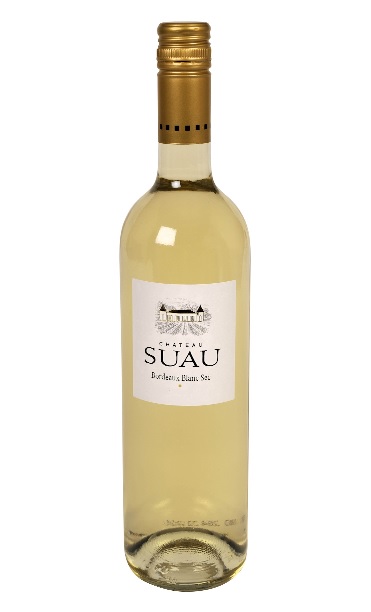
" We don't sell the wine without touching the vine "
| Country: | France |
| Region: | Bordeaux |
| Winery: | Suau |
| Grape Type: | Sauvignon Blanc |
| Organic: | Yes |
| Vintage: | 2018 |
| Bottle Size: | 750 ml |

Larroque Bordeaux Blanc is made from 73% Sauvignon Blanc and 27% Colombard.
No oak.
Color : Pale yellow with green tints.
Nose : Complex aromas of white flowers, exotic fruits, citrus and boxwood, with a touch of minerality.
Mouth : Aromatic, with a nice richness and freshness. Predominant flavors of tart, crisp fruit.
Marie-Christine, the daughter of Henri Ducourt, purchased this prestigious left-bank property in 1979, which lies on the border of the Graves appellation.
The 60-hectare vineyard was rapidly replanted and the château building, which dates from 1348, was restored.
Our family now produces three different-colored wines there: red, white and rosé.
Grown on loamy-clay soil.
Harvest : Machine harvesting in the cool, early morning
Maceration : Skin-contact maceration for several hours, depending on ripeness, and pressing
Fermentation : Beginning of the cold alcoholic fermentation (12°C / 53°F) then an increase in temperature to finish the fermentation at 20°C / 68°F.
Enjoy this wine as an aperitif or during the meal with fish, seafood or chicken salad.
Larroque Bordeaux Blanc is made from 73% Sauvignon Blanc and 27% Colombard.
No oak.
Color : Pale yellow with green tints.
Nose : Complex aromas of white flowers, exotic fruits, citrus and boxwood, with a touch of minerality.
Mouth : Aromatic, with a nice richness and freshness. Predominant flavors of tart, crisp fruit.
Marie-Christine, the daughter of Henri Ducourt, purchased this prestigious left-bank property in 1979, which lies on the border of the Graves appellation.
The 60-hectare vineyard was rapidly replanted and the château building, which dates from 1348, was restored.
Our family now produces three different-colored wines there: red, white and rosé.
Grown on loamy-clay soil.
Harvest : Machine harvesting in the cool, early morning
Maceration : Skin-contact maceration for several hours, depending on ripeness, and pressing
Fermentation : Beginning of the cold alcoholic fermentation (12°C / 53°F) then an increase in temperature to finish the fermentation at 20°C / 68°F.
Enjoy this wine as an aperitif or during the meal with fish, seafood or chicken salad.

Ambre de Maltus Bordeaux Blanc is made from 70% Sauvignon Blanc, 30% Sémillion.
Malolactic fermentation.
The wine was aged in French Oak barrels for a few month (between 6 and 8 months depending on the barrel's toastiness and cooper)
Delicious with grilled fish or grilled vegetables

Chateau Sainte Catherine Bordeaux Blanc is made from 67% Semillon and 33% Sauvignon (Sauvignon Blanc and Sauvignon Gris).
A clear and brilliant color. The first nose reveals the minerality of our terroir (limestone subsoil). Fruity and delicate aromas come to sublimate this nose in a second time. On the palate, the wine is round and charming with sustained aromas throughout the tasting. (Small red fruits and white flowers).
Chateau Sainte Catherine Bordeaux Blanc is made from 67% Semillon and 33% Sauvignon (Sauvignon Blanc and Sauvignon Gris).
A clear and brilliant color. The first nose reveals the minerality of our terroir (limestone subsoil). Fruity and delicate aromas come to sublimate this nose in a second time. On the palate, the wine is round and charming with sustained aromas throughout the tasting. (Small red fruits and white flowers).

Bling de la Ferme Blanche Sparkling Millesime is made from 90% Sauvignon Blanc and 10% Clairette.
This is a Traditional Method Vintage Sparkling wine. Grapes are coming from the region of Cassis, but this sparkling wine can't be classified as Cassis AOC as the AOC is strictly for still White, Rosé and Red.
It is made with the local grape variety : Sauvignon Blanc and Clairette.
Fine bubbles, crisp and delicate, citrus zest, lime, stone fruit.
The grapes are destemmed and sorted on a table in the cellar. Fermentation in regulated stainless steel tanks at low temperature. Aged on fine lees during three months.
This wine reveals complex aromas of honeysuckle, citrus and pineapple. It’s refreshing and expressive. An excellent depth of fruit as well as a long finish with a nice acidity. To be served at 8°- 10°C with seafood and grilled fish, or as an aperitif.
Review:
"Made from 55% Sauvignon Blanc, 35% Semillon, 10% Muscadelle; aged sur-lie for three months; a beautiful, traditional white Bordeaux with perfect fruit/acid balance and great length."
The Chateau Suau Estate
Hidden behind a row of 100-year-old oaks, Chateau Suau was once the hunting lodge of the Duc d'Epernon. It was restored in the 16th century and in 1687, during the reign of Louis XVI, the chateau was owned by the Suau family of Capian. Monique Bonnet purchased the Château in 1986. She lends her impeccable style and elegance to this Bordeaux estate that represents a great value in today’s French wine market.
Important changes have been implemented at Chateau Suau since 2008 :
1/ A change in the AOC. From the 2008 vintage on, Chateau Suau's « Premieres Cotes de Bordeaux » will now be known as « Cotes de Bordeaux and « Cotes de Bordeaux -Cadillac ».
There will no longer be « Premières Cotes de Bordeaux »
Château Suau will use the appellation "Cadillac" on its labels due to its area of production. This "village" appellation lends itself to its enduring notoriety and the image that it represents. As with its namesake, the luxury Cadillac, this wine is the "Cadillac" of wines!
As a result of these changes, all the labels and packaging have been redesigned to reflect the new appellations. These labels will be a reflection of the strong and symbolic identity with Cadillac. This AOC is made with a rigorous set of specifications, which allow it to be named after the village of Cadillac.
Chateau Suau Tradition "Premieres Cotes de Bordeaux" becomes Chateau SUAU Cotes de Bordeaux
Chateau Suau Prestige "Premieres Cotes de Bordeaux" becomes Chateau SUAU Cotes de Bordeaux - Cadillac
2/ Since 2008, Chateau Suau has been converting its vineyard to organic agriculture techniques. Certified by Ecocert, sensitive to environmental problems and consumer-concerns, this healthy, progressive and sensitive conversion will be completed in the year 2012. This action also stays true to Chateau Suau's history for exceptional quality as it was once the home of Joseph Guenant, Vice President of the Agricultural Society.
Chateau Suau is one of the first vineyards of Bordeaux to start its ISO 14 001 certification. This process begins by implementing an EMS, Environnemental Management System (SME in French) of the wines of Bordeaux, intiated by our CIVB. The EMS aims to reduce the impact of wine production on the environment while improving overall productivity.
This environmental management tool integrates both energy consumption, the sorting and recycling of waste, methods of pest control, cropping patterns, health and safety of employees, residents and consumers.....We feel that these changes complement perfectly with our approach to an organic farming culture.
The Chateau Suau Vineyard
The vineyard is situated in the Cotes de Bordeaux-Cadillac appellations, and encompasses 65 hectares (160.55 acres) of red grapes: 10% Cabernet Franc, 55% Merlot and 35% Cabernet Sauvignon; and 7 hectares (17.3 acres) of white grapes: 50% Sémillon, 30% Sauvignon, and 20% Muscadelle. The vines, planted in gravel and clay "terroir", benefit from favorable south-south east facing slopes and plateaus.
The vineyard is farmed with the culture raisonnée method, in conversion to an organic farming. The soil has a gravel and clay base. The red wines are aged in a combination of French oak barrels. No oak is used for the dry white wine produced.

St. Supery Dollarhide Estate Cabernet Sauvignon is made from 98% Cabernet Sauvignon, 2% Petit Verdot.
This Cabernet Sauvignon presents with deep, dark reds and purples. Aromas are opulent with ripe blackberry, black plum, cassis, chocolate, and toasted oak. A rich, dense profile follows with flavors of cassis and ripe black fruits, espresso, mocha, and molasses with subtle oak in influence. It is a deep, structured wine with excellent fine-grain tannin.
Review:
100% estate-grown single vineyard Cabernet Sauvignon hails from the winery’s Dollarhide Ranch. The property is known for its steep rolling hills—reaching upwards of 1,100 feet—as well as some flatlands and seven lakes rife with wildlife. Aged for 20 months in 100% French oak (54% new), the wine offers a broad and generous mouthfeel with chewy tannins. The fruit is ripe and almost gobby, becoming more streamlined as it opens up. Dark berries are lush and sweet with hints of brown sugar. Acidity and chalky lift are well defined and have the mouth imploring for that next sip. Refined, elegant, polished, and poised
-Tasting Panels 96 Points
This 100% estate-grown single-vineyard Cabernet Sauvignon hails from the winery’s Dollarhide Ranch. The property is known for its steep rolling hills—reaching upwards of 1,100 feet—as well as some flatlands and seven lakes rife with wildlife. Aged for 20 months in 100% French oak (54% new), the wine offers a broad and generous mouthfeel with chewy tannins. The fruit is ripe and almost gobby, becoming more streamlined as it opens up. Dark berries are lush and sweet with hints of brown sugar. Acidity and chalky lift are well defined and have the mouth imploring for that next sip. Refined, elegant, polished, and poised.
-Somm Journal 96 Points

In 1992 the Hill-Smith family counted themselves amongst those fortunate enough to own a vineyard upon the famous Coonawarra terra rossa soil over limestone. Experimentation, innovation, minimalist intervention and small batch winemaking has resulted in The Menzies’ reputation as a wine of longevity, elegance and structure.
Deep crimson with a plum hue. Aromas of fresh blackcurrants, mulberry, ozone, violets and exotic spices. Take a sip and you will feel the poise and tension for which great Cabernet is renowned. A wine of great complexity with flavors of blackcurrant jubes, bitter chocolate and mulberries, wrapped in divine tannins and a lovely sweet, dark fruit finish. With decanting in its youth it is enjoyable as an elegant full-bodied red wine.
Wonderful with a chargrilled rib eye on the bone or porcini mushroom, thyme and quinoa risotto.
Review:
Prune plums and blackcurrants. Violets, lavender leaf and black cherry. Olive tapenade, rosemary and crushed black peppercorn. The wine is held together by a fine mesh of grape and subtle oak tannins, intertwined with pure Coonawarra cabernet fruit. It’s chiselled in its dimension, and you might miss it, as it has such great drinking pleasure. Fruit purity, lovingly handled equals total seduction.
- Australian Wine Companion 95 Points